




Creating Career Path...

Finding Further Careers...

Lab Technician

View this career for different education levels:

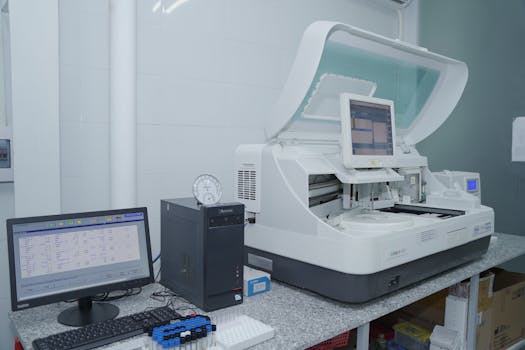
Being a Lab Technician is a really important job where you get to help scientists and researchers with their exciting work in a laboratory. Imagine a lab full of interesting equipment, chemicals, and samples. Your job would be to make sure everything runs smoothly and safely. This could mean preparing experiments, making sure all the equipment is clean and working properly, and accurately recording results. You might be measuring liquids, weighing powders, or setting up microscopes to look at tiny things. Lab Technicians work in many different places. You could be in a hospital lab helping to test patient samples, in a university lab assisting with groundbreaking research, or in a factory lab checking the quality of products like food or medicines. It is a very hands-on role where you need to be precise, organised, and good at following instructions. Safety is super important, so you will always wear protective gear like lab coats and goggles. It is a brilliant career if you love science and want to be part of discovering new things and making a real difference.

Lab Technician

Flag Media

Please select a reason for flagging this content.

📊 Statistics

Average Starting Salary

A new Lab Technician in the UK can expect to earn around 20,000 to 24,000 pounds per year, especially if they are just starting out with entry-level qualifications.

Experienced Salary Range

With a few years of experience, a Lab Technician in the UK might earn between 25,000 and 35,000 pounds annually. Those with specialist skills or in management roles could earn even more.

Job Openings

There are always opportunities for Lab Technicians across the UK in various fields like healthcare, education, research, and manufacturing. Websites like NHS Jobs, Indeed UK, and specialist science recruitment sites often list hundreds of vacancies.

🚀 Careers in this path

Flag Media

Please select a reason for flagging this content.

Biomedical Scientist Assistant

Imagine helping scientists in a hospital lab! You could prepare samples like blood or urine for testing, making sure everything is ready for diagnosing illnesses. It's like being a detective for health.

Flag Media

Please select a reason for flagging this content.

Food Science Technician

Do you love food and science? You could work in a lab that tests food to make sure it's safe to eat and tastes good! You might check ingredients, look for germs, or test new recipes.

Flag Media

Please select a reason for flagging this content.

Environmental Monitoring Assistant

This role involves helping to check our local environment. You might collect samples of water from a river or soil from a park to test in a lab, making sure our air and water are clean and safe for everyone.

Exploring Your Interest

Nurture Your Love for Science

Start by getting really curious about science subjects like Biology, Chemistry, and Physics at school. Ask lots of questions!

Pay close attention in your science lessons and try to understand how things work. If your school has a science club, join it! It's a fantastic way to do cool experiments and meet other students who love science too. The more you enjoy science now, the easier it will be to choose subjects for your GCSEs later.

Visit a Science Museum or Lab

Seeing science in action can be really inspiring! Try to visit places where science happens.

Look for science museums, university open days with lab tours, or even local health expos. These places often have interactive exhibits or demonstrations that show you what lab technicians do. It's a great way to see if working in a lab feels exciting to you and what kind of equipment they use.

Talk to Science Teachers

Your teachers know a lot about careers in science and can give you great advice.

Chat with your science teachers about what a Lab Technician does. They might know people working in labs, or they could tell you about specific science qualifications that are helpful. They can also guide you on which science subjects to choose for your GCSEs and A-Levels to keep your options open for a science career.

Building Your Foundations

Focus on GCSE Science Subjects

When you choose your GCSEs, make sure to pick strong science subjects to prepare for a lab career.

For a Lab Technician role, it's really important to do well in Science (often 'Combined Science' or separate Biology, Chemistry, and Physics) and Maths. These subjects give you the basic knowledge you'll need for understanding experiments and data. Good grades in these will open doors to further education.

Consider A-Levels or a Vocational Course

After GCSEs, you'll need to choose what you want to study next to get closer to a lab job.

You could choose A-Levels in subjects like Biology, Chemistry, Applied Science, or even Maths, which are all excellent for lab work. Another option is a vocational course like a BTEC in Applied Science, which often includes more practical, hands-on lab experience and is highly valued by employers in this field. Both pathways lead to university or apprenticeships.

Gain Practical Experience (if possible)

Any chance to get hands-on experience in a lab environment will be super helpful.

If your school offers it, try to volunteer to help out in the science labs, even if it's just helping to set up equipment or tidy up. This can give you a taste of what a real lab is like. Sometimes, local colleges or even small businesses might offer short work experience placements, which are brilliant for seeing a lab technician's daily tasks and showing your enthusiasm.

Stepping into the Career

Consider an Apprenticeship

An apprenticeship lets you learn on the job while earning money, which is a great way to become a Lab Technician.

Laboratory Technician apprenticeships are a fantastic way to get into this career. You'll work for an employer, learn practical skills from experienced technicians, and often study part-time for a qualification (like a BTEC or degree) at the same time. This means you gain valuable experience and a qualification without racking up university debt. Look for apprenticeships on the government's Find an Apprenticeship website.

Study for a Relevant Qualification

A college course or university degree can give you the deep scientific knowledge needed for lab work.

You could study a BTEC Higher National Certificate (HNC) or Diploma (HND) in Applied Science at a college, or a university degree in a science subject like Biomedical Science, Chemistry, or Analytical Science. These qualifications give you a strong scientific foundation and are often required for more specialised lab technician roles or for career progression.

Apply for Entry-Level Roles

Once you have your qualifications or apprenticeship, start looking for your first lab technician job!

Look for 'Trainee Lab Technician' or 'Junior Lab Technician' positions in hospitals, universities, pharmaceutical companies, or environmental agencies. Your application should highlight your science qualifications, any practical lab experience you've gained, and your keen interest in working in a scientific environment. Be prepared for interviews where you might discuss your understanding of lab safety and basic scientific principles.

🎬 Useful Videos

🎯 View Apprenticeships

Explore relevant apprenticeships that can help you kickstart your career in Lab Technician. Apprenticeships offer hands-on experience and training while earning a wage.

Career Progressions

This page showcases various career options and the pathways to reach them. Each career listed here shares transferable skills and knowledge, making it easier for individuals to transition between them.

Your current career is highlighted to help you see how it fits into the broader landscape of potential career choices. By clicking on any career, you can learn more about it, including the training and education required to pursue it.

Remember, progressing in your career often involves further learning and training. This page provides insights into future career options as well as those that can lead up to your current one.

These career progression decisions are informed by comparing the skills and knowledge needed for different occupations, along with data on how people move between them. Explore the possibilities and discover the exciting journey ahead in your career!

Sample Qualifications

A Lab Technician primarily performs tests, analyses, and maintains laboratory equipment, which directly aligns with the duties and responsibilities of a 'Laboratory technician'.

How to become

You can get into this job through:

  • a university course
  • a college course
  • an apprenticeship
  • applying directly

University

You can do a foundation degree, higher national diploma or degree in a scientific subject to work as a laboratory technician. 

Subjects include:

  • biomedical science
  • environmental science
  • forensic science
  • materials science
  • pharmacy
  • biology, chemistry or physics

Entry requirements

You'll usually need:

  • 5 GCSEs at grades 9 to 4 (A* to C), or equivalent, including English, maths and science
  • 3 A levels or equivalent

More Information

College

You could take a college course to help improve your chances of finding a trainee lab assistant position.

You could do a course such as:

  • applied science
  • environmental science
  • chemistry, physics or biology
  • T Level in Science

Entry requirements

Entry requirements for these courses vary.

  • 4 or 5 GCSEs at grades 9 to 4 (A* to C), or equivalent, including English and maths for a T Level

More Information

Apprenticeship

You could apply for a Laboratory Technician Level 3 Advanced Apprenticeship or a Technician Scientist Level 5 Higher Apprenticeship.

These apprenticeships can take between 2 and 3 years to complete.

Entry requirements

You'll usually need:

  • 5 GCSEs at grades 9 to 4 (A* to C), or equivalent, including English and maths, for an advanced apprenticeship
  • 4 or 5 GCSEs at grades 9 to 4 (A* to C) and A levels, or equivalent, for a higher or degree apprenticeship

More Information

Direct Application

You can apply for work as a lab technician if you have experience in a:

  • university research lab
  • clinical laboratory in a hospital
  • manufacturing or industrial research facility
  • school or college science department

More Information

Professional and industry bodies

You can register with a professional body linked to your area of work for career development and training opportunities.

Further information

You can find out more about becoming a laboratory technician from the Science Council and Health Careers.

Interested in More Career Paths?

Explore other careers or use our AI to discover personalised paths based on your interests.

Stay connected

Join our newsletter to stay up to date on features and releases

Address
Developing Experts Limited
Exchange Street Buildings
35-37 Exchange Street
Norwich
NR2 1DP
UK

Phone
01603 273515

Email
[email protected]

Copyright 2026 Developing Experts, All rights reserved.
