


Creating Career Path...

Finding Further Careers...

Astronomer

View this career for different education levels:

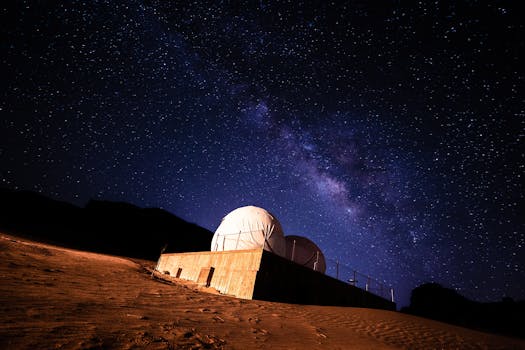
Imagine spending your days looking up at the sky and trying to understand all the amazing things out there like stars, planets, and galaxies! That is what an astronomer does. They use big telescopes to watch the sky, take pictures of distant objects, and then use computers to learn more about them. Astronomers try to figure out how the universe began, how planets like Earth were made, and even if there might be life on other planets! They are like detectives of the cosmos, always searching for clues about the big, wide universe. Astronomers often work at universities, where they also teach students about space, or at special places called observatories, which have very powerful telescopes. They spend a lot of time thinking, writing, and sharing their discoveries with other scientists. Sometimes they even travel to other countries to use giant telescopes or to talk about their exciting findings at conferences. It is a job for people who are very curious and love to solve big puzzles about space!

Astronomer

Flag Media

Please select a reason for flagging this content.

📊 Statistics

Starting Salary

A new astronomer in the UK might earn around 25,000 to 30,000 pounds a year. This is like having lots of pocket money for cool science books!

Experienced Salary

With more experience, an astronomer can earn between 35,000 and 55,000 pounds a year, or even more for very senior roles. Thats enough to buy a really big telescope!

Job Opportunities

There are not hundreds and hundreds of astronomer jobs in the UK, but there are always some exciting opportunities, especially in universities or special observatories. It is a very special job!

🚀 Careers in this path

Flag Media

Please select a reason for flagging this content.

Planet Explorer

Imagine you're a space detective! You'd use big telescopes to look at all the planets, like Mars and Jupiter, and find out what makes them special. You might even discover new ones!

Flag Media

Please select a reason for flagging this content.

Rocket Scientist

Do you love building things? A rocket scientist designs and helps build the amazing rockets that take astronauts into space. You'd make sure they're super safe and speedy!

Flag Media

Please select a reason for flagging this content.

Star Storyteller

As a star storyteller, you'd learn all about the different stars, constellations, and galaxies. Then, you'd teach other children and grown-ups about the wonders of space, sharing exciting facts and myths.

Sparking Your Space Interest

Look Up at the Night Sky

Spend time looking at the stars, the Moon, and any planets you can see from your garden or a park. Notice how they twinkle!

When you look up, try to spot different patterns of stars called constellations. You can get a star chart or use an app with your grown-up to help you find them. Watching meteor showers (shooting stars!) is also a super exciting way to get to know the night sky.

Read Books About Space

Find books in your library or at home that teach you about planets, stars, astronauts, and rockets. There are lots of amazing stories and facts to discover!

Look for non-fiction books with colourful pictures that explain big ideas about space in easy ways. Some books might even have quizzes or activities you can do. Your teacher or a grown-up can help you find the best ones.

Visit a Planetarium or Science Museum

Go with your family to a place where you can see cool shows about space or touch exhibits that teach you about science.

Planetariums often have big domes where they project images of the stars and planets, making you feel like you're really flying through space! Science museums have lots of hands-on activities, like building rockets or seeing how telescopes work, which can be great fun and teach you a lot.

Learning More About Space Science

Do Well in Science and Maths at School

Pay close attention in your science and maths lessons. These subjects are really important for understanding space.

Science helps you understand how things work, like gravity and light, which are key to astronomy. Maths helps you measure things and solve problems, like figuring out how far away stars are. The better you are at these, the easier it will be to understand bigger space ideas later on.

Join a Space Club or Astronomy Group

Ask your teachers or grown-ups if there are any clubs at school or in your local area where you can learn more about space with other children.

These clubs are fantastic because you can do fun experiments, build models of rockets or planets, and even look through telescopes with experienced people. You'll meet friends who also love space and can share what you've learned.

Watch Documentaries About Space

Watch TV shows or videos online that teach you amazing facts about the universe, narrated by clever scientists.

There are many brilliant documentaries that show incredible pictures from space and explain complex ideas in simple ways. Ask your grown-up to help you find age-appropriate ones. These can show you what real astronomers do and what kind of amazing discoveries they make.

Becoming a Space Explorer

Go to University to Study Physics or Astronomy

After school, you'll need to go to university to learn lots and lots about science, especially about space.

At university, you'll study subjects like physics, which teaches you about energy, forces, and how matter behaves, and astronomy, which focuses specifically on celestial objects and the universe. You'll learn how to use special equipment and do your own research, preparing you for a career as an astronomer.

Get a Special Degree (PhD)

To become a proper astronomer, you often need to study even more after your first university degree, to become an expert in a special area of space.

This extra studying is called a PhD. During a PhD, you'll work on your very own big project, doing new research and making discoveries that no one has made before! This is where you really start to become a space expert and contribute new knowledge to the world.

Work at an Observatory or University

Once you're super knowledgeable, you can work with huge telescopes, study data, and teach others about the universe.

Astronomers often work at observatories, using powerful telescopes to gather information about space, or at universities, where they do research and teach students. You might even get to travel to different countries to use some of the biggest telescopes in the world and collaborate with other scientists, helping us understand the cosmos better.

🎬 Useful Videos

🎯 View Apprenticeships

Explore relevant apprenticeships that can help you kickstart your career in Astronomer. Apprenticeships offer hands-on experience and training while earning a wage.

Career Progressions

No career progressions found for Astronomer

Sample Qualifications

How to become

You can get into this job through a university course.

University

You'll need a degree and postgraduate qualification to work as an astronomer. You'll usually need to have achieved a first class honours or 2:1 in your degree.

Relevant subjects include:

  • maths
  • physics
  • astrophysics
  • geophysics
  • astronomy
  • space science

You can also do an extended 4-year degree to get a postgraduate master's qualification. These courses include more independent research and can lead on to a PhD.

Many employers will expect you to have completed, or be working towards, a PhD in your specialist area of interest.

Entry requirements

You'll usually need:

  • 5 GCSEs at grades 9 to 4 (A* to C), or equivalent, including English, maths and science
  • 2 or 3 A levels, or equivalent, including maths and physics
  • a degree in a relevant subject for postgraduate study

More Information

More Information

Career tips

You can join an amateur astronomy group and attend astronomy summer schools to share your interest in space, make connections and get hands-on observation experience.

Further information

You can find out more about careers in astronomy from the Royal Astronomical Society and SpaceCareers.uk.

Interested in More Career Paths?

Explore other careers or use our AI to discover personalised paths based on your interests.

Stay connected

Join our newsletter to stay up to date on features and releases

Address
Developing Experts Limited
Exchange Street Buildings
35-37 Exchange Street
Norwich
NR2 1DP
UK

Phone
01603 273515

Email
[email protected]

Copyright 2026 Developing Experts, All rights reserved.
