




Creating Career Path...

Finding Further Careers...

Materials Scientist

View this career for different education levels:

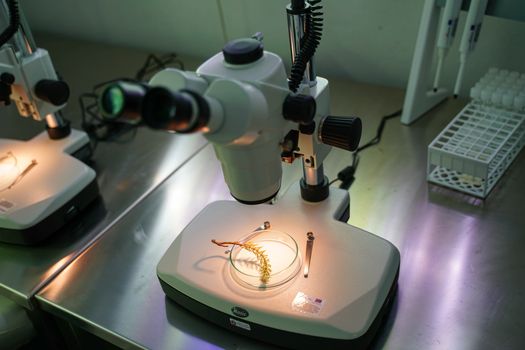
Imagine a world where everything is made from different stuff – from the phone in your hand to the aeroplane in the sky. A Materials Scientist is like a detective who studies these 'stuffs', called materials. They investigate why things are strong or weak, shiny or dull, and how they behave. Their main goal is to understand how materials work and how to make new and better ones. This could mean creating super-strong metals for buildings, new plastics that can recycle easily, or special fabrics for sports gear. They might spend time in a lab looking at tiny particles under a microscope, or testing how materials react to heat or pressure. It's a bit like being a chef, but instead of cooking food, they are cooking up new materials with amazing properties! This job involves a lot of problem-solving and being curious about how things are made. Materials Scientists help design everything from medical implants that save lives to more efficient solar panels that protect our planet. They work in many different places, such as universities doing research, big companies making products, or even government labs. They need to be good at science, especially chemistry and physics, and enjoy experimenting. It's a career where you can really make a difference by helping to create the innovations of the future.

Materials Scientist

Flag Media

Please select a reason for flagging this content.

📊 Statistics

Average Starting Salary

Starting salaries for Materials Scientists in the UK can typically range from 24,000 to 30,000 pounds per year, especially for graduates.

Experienced Salary Range

With a few years of experience, a Materials Scientist in the UK might earn between 35,000 and 55,000 pounds annually. Highly experienced or senior roles can go above 60,000 pounds.

Job Growth Outlook

The demand for skilled Materials Scientists in the UK is steady, with new advancements in technology and sustainability driving opportunities in various industries.

🚀 Careers in this path

Flag Media

Please select a reason for flagging this content.

Materials Engineer

Materials Engineers design and test new materials to make sure they're strong, safe, and useful for things like building bridges or making faster aeroplanes. They learn how different materials behave and how to improve them.

Flag Media

Please select a reason for flagging this content.

Nanotechnologist

Nanotechnologists work with tiny materials, so small you can't even see them without special equipment. They create new things at a super-small level, like making tiny robots for medicine or developing super-strong, lightweight fabrics.

Flag Media

Please select a reason for flagging this content.

Forensic Materials Scientist

Forensic Materials Scientists help solve crimes by analysing tiny clues made of different materials, like fibres from clothes, paint chips from a car, or even a tiny piece of metal. They use science to figure out what happened.

Build a Strong Foundation

Excel in Science and Maths

Focus on your science subjects (especially physics and chemistry) and maths at school. These are the core tools you'll need.

To become a materials scientist, understanding how atoms and molecules fit together is key, which is taught in chemistry. Physics helps you understand why materials behave in certain ways, like how strong they are or how they conduct electricity. Maths is essential for problem-solving and analysing data in science. Aim for good grades in these subjects throughout your secondary school years, as they will be crucial for college and university applications.

Explore STEM Clubs and Activities

Join science clubs, attend workshops, or visit science museums to see real-world science in action.

Many schools offer STEM (Science, Technology, Engineering, and Maths) clubs where you can do fun experiments and build things. Look for opportunities to participate in science fairs or engineering challenges. Visiting science and technology museums, like the Science Museum in London or the Catalyst Science Discovery Centre, can spark your interest and show you different aspects of materials science. These activities help you discover what you enjoy and build practical skills.

Read About Materials Science

Look up how everyday things are made and what new materials are being invented.

There are lots of fascinating articles and videos online about materials science. You could read about how a smartphone screen is made, what makes a bulletproof vest work, or how scientists are creating new, eco-friendly plastics. Websites like the Institute of Materials, Minerals and Mining (IOM3) or university materials science departments often have accessible information. Understanding these concepts early can deepen your interest and knowledge.

Further Your Education

Choose A-Levels or Equivalent

Select A-levels (or equivalent qualifications like BTEC) in relevant subjects after your GCSEs.

After your GCSEs, you'll typically need A-levels in Maths, Physics, and Chemistry to get onto a university degree course in Materials Science or a related engineering field. Some universities might also accept subjects like Further Maths or Computer Science. If you choose a BTEC qualification, look for one in Engineering or Applied Science which can also provide a good pathway. Check university entry requirements for specific courses you might be interested in.

University Degree

Study for a university degree in Materials Science, Materials Engineering, or a closely related field.

Most materials scientists have a Bachelor's degree (BSc or BEng) in Materials Science, Materials Engineering, or a similar subject like Physics, Chemistry, or Mechanical Engineering with a materials specialism. Look for accredited courses at reputable universities across the UK. Some universities offer integrated Master's degrees (MEng) which can be a good option for a deeper dive and are often preferred by employers. During your degree, you'll learn about different types of materials, how to test them, and how to design new ones.

Consider a Master's or PhD

For advanced research or specialist roles, further study at Master's or PhD level can be beneficial.

While a Bachelor's degree is often enough for entry-level roles, many materials scientists, especially those involved in cutting-edge research and development, pursue a Master's (MSc) or even a PhD. A Master's degree allows for specialisation in a particular area of materials science, such as biomaterials or nanomaterials. A PhD involves conducting original research and is often required for academic positions or senior research roles in industry.

Gain Experience and Specialise

Seek Work Experience or Internships

Try to get some work experience during your studies, even if it's just for a few weeks.

During your university holidays, look for internships or work placements with companies that develop or use materials. This could be in aerospace, automotive, electronics, or even medical device companies. Many universities also offer sandwich courses which include a year in industry. Real-world experience helps you apply what you've learned and build a network of contacts in the field, making you more attractive to employers after you graduate.

Join Professional Organisations

Become a student member of professional bodies related to materials science.

Organisations like the Institute of Materials, Minerals and Mining (IOM3) or the Royal Society of Chemistry offer student memberships. These give you access to industry news, networking events, mentoring opportunities, and resources that can help you understand the current trends and challenges in materials science. It's a great way to meet people who are already working in the field and learn from their experiences.

Develop Specialist Skills

Identify an area of materials science that interests you and learn more about it.

Materials science is a vast field. You might be interested in polymers, ceramics, metals, composites, biomaterials, or nanomaterials. Think about what excites you and try to take elective modules in that area during your degree. Developing a specialism can help you stand out and target specific job roles, for example, working on new materials for sustainable energy or developing advanced prosthetics.

🎬 Useful Videos

🎯 View Apprenticeships

Explore relevant apprenticeships that can help you kickstart your career in Materials Scientist. Apprenticeships offer hands-on experience and training while earning a wage.

Career Progressions

This page showcases various career options and the pathways to reach them. Each career listed here shares transferable skills and knowledge, making it easier for individuals to transition between them.

Your current career is highlighted to help you see how it fits into the broader landscape of potential career choices. By clicking on any career, you can learn more about it, including the training and education required to pursue it.

Remember, progressing in your career often involves further learning and training. This page provides insights into future career options as well as those that can lead up to your current one.

These career progression decisions are informed by comparing the skills and knowledge needed for different occupations, along with data on how people move between them. Explore the possibilities and discover the exciting journey ahead in your career!

Sample Qualifications

A Materials Scientist primarily focuses on researching and developing new materials, which closely aligns with the work of a Materials Engineer who designs, processes, and tests materials for specific applications. Both roles require a deep understanding of material properties and their behaviour.

How to become

You can get into this job through:

  • a university course
  • an apprenticeship

University

You'll normally need a foundation degree, higher national diploma or degree in a subject, like:

  • materials engineering
  • materials science or technology
  • applied chemistry
  • applied physics

You could also take a degree course specialising in one group of materials or their commercial use, for example:

  • metallurgy
  • biomaterials
  • polymer science
  • sports engineering

If you have a related degree, for example, structural engineering, you may be able to take a postgraduate course in materials science and engineering.

You can search for materials science and engineering courses, accredited by the Institute of Materials, Minerals and Mining, on the Engineering Council website.

Entry requirements

You'll usually need:

  • 1 or 2 A levels, or equivalent, for a foundation degree or higher national diploma
  • 2 or 3 A levels, or equivalent, including maths and a science for a degree
  • a degree in a relevant subject for postgraduate study

More Information

Apprenticeship

You could apply for a degree apprenticeship to begin your materials engineering career. Examples include:

  • Materials Science Technologist Level 6
  • Space Systems Engineer Level 6
  • Materials Process Engineer Level 7

Entry requirements

You'll usually need:

  • 4 or 5 GCSEs at grades 9 to 4 (A* to C) and A levels, or equivalent, for a degree apprenticeship

More Information

More Information

Career tips

Choosing to do an accredited course or a degree apprenticeship can help towards registration for incorporated or chartered engineer status with a professional body. This is a way to demonstrate your professional competence and expertise as your career progresses.

Further information

You can find out more about careers in materials science and engineering from:

Interested in More Career Paths?

Explore other careers or use our AI to discover personalised paths based on your interests.

Stay connected

Join our newsletter to stay up to date on features and releases

Address
Developing Experts Limited
Exchange Street Buildings
35-37 Exchange Street
Norwich
NR2 1DP
UK

Phone
01603 273515

Email
[email protected]

Copyright 2026 Developing Experts, All rights reserved.
