




Creating Career Path...

Finding Further Careers...

Standardised career name

View this career for different education levels:

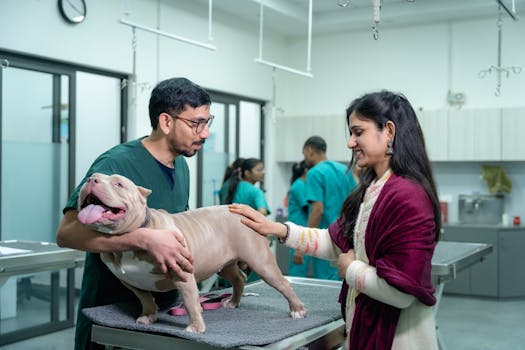
Being a Veterinary Surgeon means you are a doctor for animals! You look after the health and wellbeing of all sorts of creatures, from fluffy pets like cats and dogs to farm animals like cows and sheep, and sometimes even exotic animals in zoos or wildlife centres. Your day might involve checking animals for illnesses, giving them vaccinations, performing operations, and providing advice to their owners on how to keep them healthy. It is a very rewarding job because you get to help animals feel better and make a big difference to their lives and the lives of their human families. To become a vet, you need to study hard at university for about five or six years to get a special degree. It requires a lot of science knowledge, especially biology and chemistry, and a real passion for animals. Vets need to be good at solving problems, making quick decisions, and communicating clearly with both animal owners and their colleagues. It can be a challenging but incredibly satisfying career, where every day can bring something new and exciting.

Standardised career name

Flag Media

Please select a reason for flagging this content.

📊 Statistics

Starting Salary

For newly qualified vets in the UK, the starting salary is usually around 28,000 to 35,000 pounds per year.

Experienced Salary

With more experience, a veterinary surgeon can earn between 45,000 to 70,000 pounds annually, and even more if they specialise.

Number of Vets in UK

There are over 25,000 veterinary surgeons registered to practice in the UK, working in various settings.

🚀 Careers in this path

Flag Media

Please select a reason for flagging this content.

Game Designer

Helps think up the ideas for new computer games, including the characters, stories, and how players win. It's like being a storyteller and an architect for virtual worlds!

Flag Media

Please select a reason for flagging this content.

Level Designer

Focuses on building the individual stages or 'levels' within a game. They decide where challenges go, where characters appear, and how players move through the game's environment.

Flag Media

Please select a reason for flagging this content.

Narrative Designer

Writes the story, dialogue, and lore for video games. They make sure the plot makes sense and that the characters have interesting things to say, bringing the game's world to life.

Build Your Foundations

Excel in Science Subjects

Focus on getting good grades in science subjects at school, especially biology and chemistry, as these are super important for understanding how animals work.

At GCSE level, aim for strong passes, preferably grades 7-9 (A-A*) in Science subjects like Biology, Chemistry, and Physics, and also Maths. These subjects will give you the essential scientific knowledge needed for A-Levels and university. English is also important for communication skills.

Gain Relevant A-Levels

Choose A-Levels that universities look for when applying for veterinary medicine, like Biology and Chemistry, as these are usually mandatory.

Most UK veterinary schools require A-Levels in Chemistry and Biology. Some may also ask for a third science subject like Physics or Maths, or a good grade in another strong academic subject. Aim for top grades (usually A*AA or AAA) to be competitive for university entry.

Develop Practical Experience

Start gaining experience working with animals in different settings, which shows your commitment and understanding of animal care.

Universities want to see that you've experienced different aspects of animal care. This could include volunteering at a local veterinary practice, working on a farm, helping at an animal rescue centre, or even assisting at a stables. Try to get a variety of experiences with different species (e.g., small animals, farm animals, horses) to show broad interest and commitment. Keep a logbook of your experiences!

University and Training

Apply for Veterinary School

Once you have your A-Levels and experience, apply to one of the UK universities that offer a degree in Veterinary Medicine.

There are several universities in the UK that offer a Bachelor of Veterinary Science (BVSc) or Bachelor of Veterinary Medicine (BVM) degree, such as the Royal Veterinary College, University of Cambridge, University of Liverpool, University of Edinburgh, and University of Nottingham. The application process is competitive and involves UCAS, personal statements, and often interviews. Make sure your personal statement highlights your passion for veterinary science and all your relevant work experience.

Complete Your Degree

Study hard for about 5-6 years at university to learn everything you need to know about animal health, diseases, and treatments.

The veterinary degree is an intensive course covering a wide range of subjects including anatomy, physiology, pharmacology, pathology, clinical skills, and animal welfare. It involves lectures, practical sessions, and rotations through different clinical departments. You'll learn how to diagnose and treat illnesses, perform surgery, and manage animal care. The degree is generally 5-6 years long, including periods of practical work experience.

Undertake Clinical Placements

Throughout your degree, you'll complete supervised placements in veterinary practices to get real-world experience and apply your learning.

These placements, often called 'extramural studies' (EMS), are a crucial part of your veterinary training. You'll spend time in various settings like small animal practices, farm animal practices, equine hospitals, and even laboratories. This hands-on experience allows you to observe and participate in daily veterinary work, developing your practical skills and confidence before you qualify. Your university will have specific requirements for the type and amount of EMS you need to complete.

Becoming a Professional

Register with RCVS

After graduating, you must register with the Royal College of Veterinary Surgeons (RCVS) to legally practice as a vet in the UK.

The RCVS is the regulatory body for veterinary surgeons in the UK. Once you've successfully completed your veterinary degree, you'll apply to become a Member of the Royal College of Veterinary Surgeons. This registration is mandatory and confirms that you meet the professional standards and ethical guidelines required to practice veterinary medicine. It's a significant milestone that signifies you are now a qualified vet!

Start Your First Job

Look for a graduate position, often called a 'new graduate' role, where you'll continue to learn and gain experience under supervision.

Many new graduates start in mixed or small animal practices, often with structured mentorship programmes to help them transition from student to qualified vet. These roles are designed to provide support as you gain confidence and refine your clinical skills in a real-world setting. You'll typically be involved in consultations, surgeries, and emergency care, gradually taking on more responsibility.

Continue Professional Development

As a vet, you'll always be learning new things! You'll need to keep up-to-date with the latest treatments and research to provide the best care.

Veterinary medicine is constantly evolving, so continuous professional development (CPD) is a lifelong requirement. This involves attending courses, workshops, conferences, and reading scientific journals to stay informed about new techniques, medications, and research. RCVS requires vets to complete a certain number of CPD hours each year to maintain their registration. You might also choose to specialise in a particular area, like surgery, dermatology, or exotic animals, which would involve further advanced training and qualifications.

🎬 Useful Videos

🎯 View Apprenticeships

Explore relevant apprenticeships that can help you kickstart your career in Standardised career name. Apprenticeships offer hands-on experience and training while earning a wage.

Career Progressions

This page showcases various career options and the pathways to reach them. Each career listed here shares transferable skills and knowledge, making it easier for individuals to transition between them.

Your current career is highlighted to help you see how it fits into the broader landscape of potential career choices. By clicking on any career, you can learn more about it, including the training and education required to pursue it.

Remember, progressing in your career often involves further learning and training. This page provides insights into future career options as well as those that can lead up to your current one.

These career progression decisions are informed by comparing the skills and knowledge needed for different occupations, along with data on how people move between them. Explore the possibilities and discover the exciting journey ahead in your career!

Sample Qualifications

A 'Standardised career name' implies a role focused on providing guidance and information on various career paths, which aligns directly with the duties of a Careers Adviser. They help individuals understand different professions and the qualifications required.

How to become

You can get into this job through:

  • a university course
  • an apprenticeship
  • working towards this role

University

You can do a postgraduate diploma, or master's degree, in career guidance after completing an undergraduate degree in any subject.

Postgraduate courses take 1 year full time or 2 years part time and lead to the Qualification in Career Development (QCD).

People often apply to do a postgraduate career guidance qualification after working in teaching, youth work or social services.

Entry requirements

You'll usually need:

  • a degree in any subject for a postgraduate course

More Information

Apprenticeship

You could apply to do a Career Development Professional Level 6 (non-degree) Apprenticeship.

This takes 2 years to complete.

You may be able to do an Employability Practitioner Level 4 Higher Apprenticeship, if you're working in careers or education, then go on to complete a level 6 career guidance qualification.

Entry requirements

Employers will set their own entry requirements.

More Information

Work

You could start by working as a careers co-ordinator, employment support adviser or youth worker and do further training on the job.

Your employer may support you to take work-based qualifications, such as:

  • Level 4 Diploma in Career Information and Advice
  • Level 6 Diploma in Career Guidance and Development

Volunteering

Volunteering with job support, advice or mentoring organisations could give you an advantage when applying for training or jobs.

Find out about local opportunities for voluntary work through the National Council for Voluntary Organisations or Do IT.

More Information

Professional and industry bodies

Once you're qualified, you can apply to join the Career Development Institute's UK register of career development professionals.

Further information

You can find out more about becoming a careers adviser from the Career Development Institute.

Interested in More Career Paths?

Explore other careers or use our AI to discover personalised paths based on your interests.

Stay connected

Join our newsletter to stay up to date on features and releases

Address
Developing Experts Limited
Exchange Street Buildings
35-37 Exchange Street
Norwich
NR2 1DP
UK

Phone
01603 273515

Email
[email protected]

Copyright 2026 Developing Experts, All rights reserved.
