This blog explains what World Space Week is, why it's worth celebrating in schools, and offers practical ideas for teachers, alongside Developing Experts' space units for Year 5, KS3 and KS4.

Estimated read time: 4 minutes
Ask a class of children what they'd like to be when they grow up, and there's a good chance someone will say "astronaut." Ask them what's out there beyond the stars, and the hands shoot up faster than you can count them.
Space has a way of capturing curiosity like nothing else. It's huge, mysterious and full of questions that even the world's leading scientists are still trying to answer. That's exactly what makes World Space Week such a brilliant opportunity for schools: a whole week dedicated to looking up, asking big questions, and discovering where a love of space could lead.
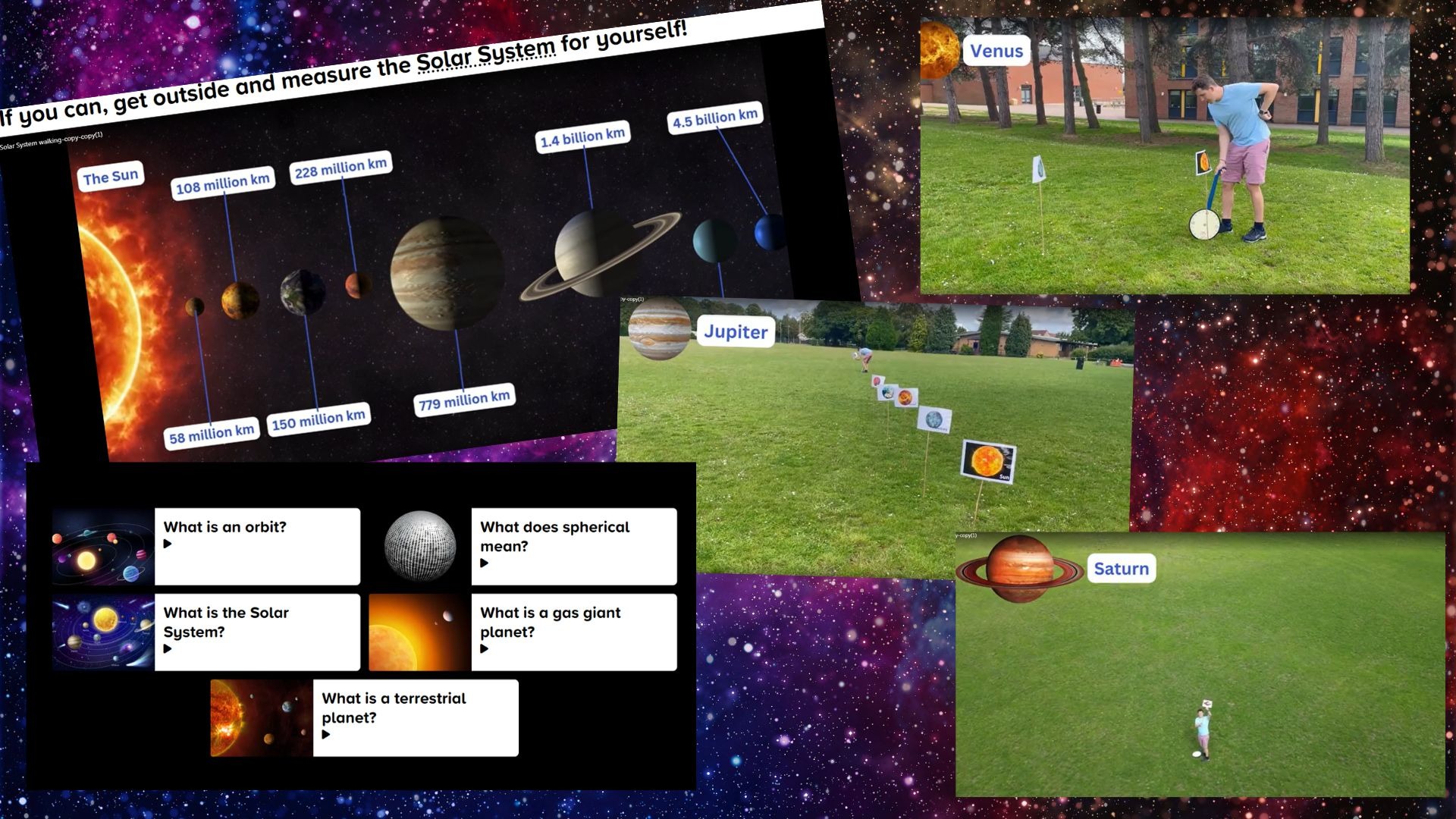
To celebrate World Space Week, we're making our special lesson, Explore the Solar System and its Planets, completely free for teachers. It opens with an exciting launch video to get pupils buzzing, followed by a hands-on activity all about space - everything you need to bring the wonders of our Solar System into your classroom this week, with no planning required.
World Space Week is an international celebration of space science and technology, held every year from 4 to 10 October. It was declared by the United Nations General Assembly in 1999 and is now one of the largest annual space events on the planet, with schools, space agencies, museums and science organisations in countries all over the world taking part.
The dates weren't chosen at random. On 4 October 1957, the Soviet Union launched Sputnik 1, the first human-made satellite to orbit the Earth - the moment the Space Age began. On 10 October 1967, the Outer Space Treaty came into force, setting out the principles for the peaceful exploration and use of outer space. World Space Week sits neatly between the two.
Each year has its own theme, but the aim stays the same: to celebrate how space science improves life on Earth, and to inspire the next generation of scientists, engineers and explorers.
Space is one of those rare topics that excites almost every learner, whatever their age or starting point. World Space Week gives teachers a ready-made reason to tap into that enthusiasm and turn it into meaningful learning.
It makes science real. Concepts such as gravity, orbits, forces and light can feel abstract on a worksheet. Linked to rockets, satellites and astronauts, they suddenly make sense - and stick.
It opens doors to careers. The UK space sector is growing fast, and it needs far more than astronauts. Engineers, data scientists, software developers, technicians, designers and communicators all play their part. Showing pupils these pathways early helps them see a future in STEM that they might never have imagined for themselves. Our lesson above is sponsored by the Ministry of Defence, and pupils hear from a graduate physicist during the lesson, making those real connections to careers.
It works across the curriculum. Space connects naturally to maths, geography, history, art, English and computing, so a single theme can enrich a whole week of learning - or even a whole school.
And perhaps most importantly, it builds curiosity. The questions children ask about space - Is anyone else out there? How big is the universe? Could I live on Mars? - are exactly the kind of questions that turn pupils into scientists.
Whether you have five minutes or five days, there are plenty of ways to bring World Space Week to life:
• Launch with our free lesson. Open an assembly or lesson with the video on slide 19 to get everyone talking.
• Build and launch rockets. Bottle rockets or straw rockets are a fantastic hands-on way to explore forces, air resistance and fair testing.
• Go stargazing. Encourage families to step outside on a clear evening and spot the Moon, planets and constellations - free stargazing apps make it easy.
• Track the International Space Station. Look up when the ISS will next pass overhead and challenge pupils to spot it from home.
• Make a scale model of the Solar System. Take it outside onto the playground or field to show just how vast the distances between planets really are.
• Meet a space professional. Use Developing Expert’s career and expert films to introduce pupils to real people working in the sector.
• Design a mission. Challenge pupils to plan a mission to the Moon or Mars - what would they need to survive, and how would they get there?
• Write from space. Pupils imagine life aboard a space station and write diary entries, news reports or letters home.
• Create space art. Galaxy paintings, planet mobiles or alien landscapes are perfect for a whole-school display.
• Run a space quiz or debate. Should humans live on Mars? Is space exploration worth the cost? Big questions make for brilliant discussion.
Our Year 5 unit introduces pupils to the Solar System, exploring the movement of the Earth, Moon and planets, and explaining day and night through hands-on investigation. It's the ideal foundation for a lifelong interest in space.
At Key Stage 3, learners build on that foundation, exploring gravity, the seasons, and the place of our Solar System within the wider universe. It's where big ideas start to connect.
Our KS4 unit takes students further into space physics, from orbits and the life cycle of stars to the evidence for how the universe began - supporting GCSE study while showing where these ideas lead in the real world.
World Space Week is a reminder that the next astronaut, rocket engineer or space scientist could be sitting in your classroom right now. A single lesson, video or stargazing session might be the spark that sets them on their way.
If you're new to Developing Experts, you can explore all of our space units, career films and AI tools with a free two-week trial. Simply visit www.developingexperts.com to sign up today.
Address
Developing Experts Limited
Exchange Street Buildings
35-37 Exchange Street
Norwich
NR2 1DP
UK
Phone
01603 273515
Email
[email protected]
Copyright 2026 Developing Experts, All rights reserved.

Unlock expert-designed lessons, resources, and assessments tailored for educators. No credit card required.
Claim Your Free Trial →We use cookies to enhance your browsing experience and analyze our traffic. Learn more.

