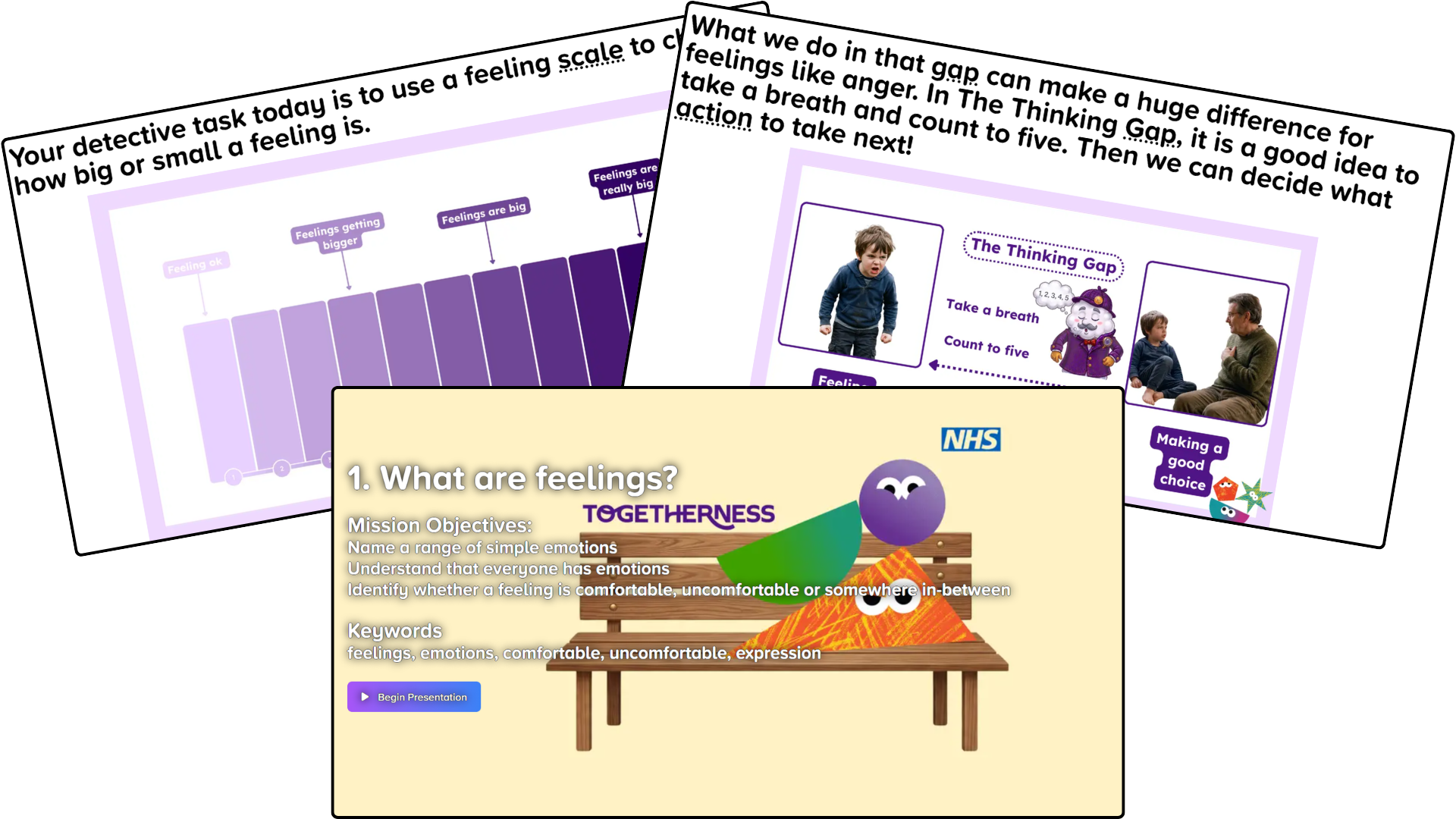
This blog introduces a free six-lesson KS1 wellbeing unit created with Togetherness, an NHS emotional health team, covering how children learn to name their feelings, notice them in their bodies, measure how big they are and ask for help.

Estimated read time: 5 minutes
You know the moment. A child comes in from the playground, and something has gone wrong. You ask what happened and get a shrug, or tears, or a shove aimed at whoever is nearest. The feeling is much bigger than any words they have for it, and that's usually where things go wrong.
Now imagine the same child, a few weeks later, walking over to you and saying: "Can you help me with this big feeling?"
That sentence is the heart of our new Key Stage 1 Wellbeing unit, created with Togetherness, an NHS emotional health team, and free for every teacher from today, 1st October 2026. The unit provides a ready-to-teach set of KS1 wellbeing lessons that support statutory Relationships and Health Education and wider PSHE provision.
The six lessons were written by Dr Hazel Douglas MBE, Consultant Clinical Psychologist and Child Psychotherapist, then shaped by our team of qualified primary teachers into an interactive unit with everything you need to teach it.
The model behind the lessons rests on a simple idea: behaviour is communication, and relationships are the foundation for development. Togetherness is an NHS emotional health team based at University Hospitals Birmingham NHS Foundation Trust, and their approach was developed by Dr Hazel Douglas with NHS practitioners in Solihull's Child and Adolescent Mental Health Services. More than 60,000 practitioners across health, education and social care now use it.
Young children feel everything enormously. What they often lack is the vocabulary to name it, the awareness to notice it building, and the confidence to tell someone before it spills over.
This unit doesn't teach children to push feelings away or cheer up. Instead, children learn to sit with a feeling, name it, notice where it lives in their body, and judge how big it has grown. Every emotion gets space rather than being squashed or ignored.
One thing sets this apart from most wellbeing schemes: the adults join in, in every lesson. Through our videos and the guidance in our lesson plans, teachers and support staff are encouraged to share their own feelings and take part as equals. Children learn to handle emotions largely by watching the adults around them do it. A teacher saying "My hands feel sweaty before assembly because I'm nervous" teaches more than any slide will.
Across the unit, children become Emotion Detectives, building a toolkit they carry from one lesson to the next. We encourage teachers to keep using it outside the lessons too, whenever a big feeling comes up.
Children discover that everyone has feelings and that all of them are okay. Using mirrors, they explore different expressions before creating a personalised emotion fan, which becomes a tool they use throughout the unit to identify and communicate how they feel.
Children begin to develop an awareness of what's happening inside their bodies without needing extensive emotional vocabulary. Through simple physical activities and photographs, they investigate the visible and invisible clues that can help us recognise emotions, and discover that the same behaviour can mean different things.
Children learn that feelings can grow bigger or smaller, like the volume on a TV. They use a feelings scale to track a character's emotions as a story unfolds and explore how another person's help can change how someone feels. They then identify their own special person and practise asking: "Can you help me with this big feeling?"
Children discover the Thinking Gap between feeling something and deciding what to do next. They practise pausing, breathing and counting to five before choosing from a range of strategies that can help, then apply the routine through sorting and role-play activities.
Children explore worry as a normal and sometimes useful feeling before learning a simple four-step routine to help before worries become uncomfortable. They apply it to different scenarios and identify a special person they can approach when they need support.
The unit closes by connecting mind and body. Children explore how sleep, movement, time outdoors, food, water and relationships can affect how they feel, before identifying healthy habits of their own.
Finally, they receive their Emotion Detective certificate - they can now name a feeling, notice it in their body, judge how big it is and know who to take it to.
Every lesson comes with a Teacher Mastery, guidance written for the trickiest parts of this teaching, not just the delivery of it.
How the Unit Supports KS1 Relationships and Health Education
The unit supports statutory Relationships and Health Education, as well as wider PSHE provision, with each lesson clearly identifying the outcomes it covers. Across the six lessons, children learn to recognise and name a range of emotions; understand that feelings can vary in size and intensity; notice how emotions can affect their bodies and behaviour; identify when and how to seek support; and practise simple strategies for looking after their emotional wellbeing.
The unit also supports statutory learning around self-care, including rest, time outdoors and time with friends and family, while giving children practical opportunities to develop the vocabulary and confidence to talk about how they feel.
Togetherness recommends teaching the unit once children have settled into Year 1, then repeating it as they move into Year 2.
The full six-lesson unit goes live today, 1st October 2026, and is free for every teacher. You'll find it in our unit library, along with every handout you need - emotion fan templates, the feelings scale, sorting cards, worry scenarios, the strategies poster, postcards and certificates.
If you're new to Developing Experts, you can also explore our full Science, Geography and History curricula with a free two-week trial. Simply visit www.developingexperts.com to sign up today.
Most of what children learn about handling feelings, they learn by watching the adults around them. This unit gives them the words to go with it: a way to name what's happening, a scale to measure it, a pause before they act, and how to ask for help.
"Can you help me with this big feeling?" is a lot for a five-year-old to be able to say. It takes practice. But it's one of the most useful sentences a child will learn all year.
Address
Developing Experts Limited
Exchange Street Buildings
35-37 Exchange Street
Norwich
NR2 1DP
UK
Phone
01603 273515
Email
[email protected]
Copyright 2026 Developing Experts, All rights reserved.

Unlock expert-designed lessons, resources, and assessments tailored for educators. No credit card required.
Claim Your Free Trial →We use cookies to enhance your browsing experience and analyze our traffic. Learn more.