This blog explains the government's plans to restore Key Stage 3 as a distinct phase, why the change is happening, what it means for science teaching in Years 7 to 9, and how the Developing Experts KS3 science curriculum supports it.

Estimated read time: 5 minutes
Here's a quick test for any secondary teacher. In one sentence, what is Year 9 science for?
Year 11 is easy to answer, and the same goes for Year 13. But Year 9 usually takes more thought, and the answer will vary from school to school. Some teachers will talk about laying foundations. Others will admit that, in practice, it has quietly become the start of the GCSE course.
This uncertainty is at the heart of the government's latest announcement to restore Key Stage 3 as a distinct three-year phase, with a purpose of its own, as part of the new National Curriculum.
The new National Curriculum will slim down overcrowded content and sequence it better across every key stage. The aim is to create more space for deeper understanding and richer experiences that ignite a love of learning, and to make sure more children are stretched and make progress.
For Key Stage 3, that comes with a clear expectation. Schools should not start GCSE specifications early for whole cohorts, ask students to narrow their options early, or enter them for exams ahead of time. However, teachers will still have the flexibility to stretch students or groups who are ready to go further.
There will also be higher expectations around oracy, reading and numeracy. All of this sits alongside the enrichment framework published in June 2026, which encourages schools to make room for experiences beyond the classroom, from practical experiments to debate.
The first sign of what the revised curriculum will look like is expected to go out for public consultation by the end of this year. First teaching is planned for September 2028.
The case for change rests on two problems.
The first is disengagement. Too many children are switching off from school in their early teens, and it shows in their attendance, their attainment and, eventually, their life outcomes. The move from primary to secondary is a particular pressure point, and the effects tend to build through Years 7 to 9.
The second is pace. Many students are missing out on the rich, specialist education they should expect at secondary school, or are being rushed through content before they have grasped the fundamentals. When GCSE preparation starts early, often because there is simply too much content to fit into two years, the early secondary years narrow to fit the exam. Students move on without grasping the fundamentals or developing deeper understanding.
Among teachers, there's broad agreement that KS3 has lacked a clear identity, yet there's less agreement on what that identity should be. Some would like a curriculum that stands completely apart from GCSE preparation. Others want a clearer purpose for the phase while still building steadily towards exams.
Many also feel that KS3 has been treated as less of a priority than the exam years, with less teaching time, leadership attention and resourcing. Teaching Year 11 is often seen as the more desirable timetable.
Some in the education sector are raising a note of caution, too. Without a shared understanding of what KS3 is for, reforms could create a lot of activity and additional workload, without actually changing much for the students sitting in those classrooms.
Science is a good example of why a distinct KS3 doesn't mean a disconnected one.
Good KS3 science has a job of its own. It gives students time to properly grasp the ideas that the rest of their science education depends on, such as particles, cells, energy and forces. It builds the skills of planning, measuring, evaluating and explaining. And it does this in a way that is interesting in its own right, at an age when many students are deciding whether science is for them.
For example, a student who has looked at onion cells under a microscope, or watched an electromagnet pick up a string of paperclips, will want to know why, and that gives them a reason to care about the theory behind it. Practical work is one of the clearest ways to give students the richer experiences the reforms describe, and the Curriculum and Assessment Review has already asked for the purpose of practical work to be made clearer.
Talk is crucial, too. Explaining a result, arguing for a prediction or questioning someone else's conclusion are all part of thinking scientifically, and they fit naturally with the new emphasis on oracy.
None of this means losing sight of GCSE. In fact, students who leave Year 9 with secure foundations and real confidence in practical work are in a much stronger position for Year 10.
Our KS3 science curriculum was designed as a phase in its own right. It builds on primary science and prepares students for GCSE without teaching the specification early.
A coherent three-year sequence. The curriculum is made up of 25 units in a suggested teaching order across Years 7 to 9. It moves between biology, chemistry and physics, so students begin to see how the three connect. Every unit ends with a revision lesson, and retrieval practice runs throughout to help knowledge stick.
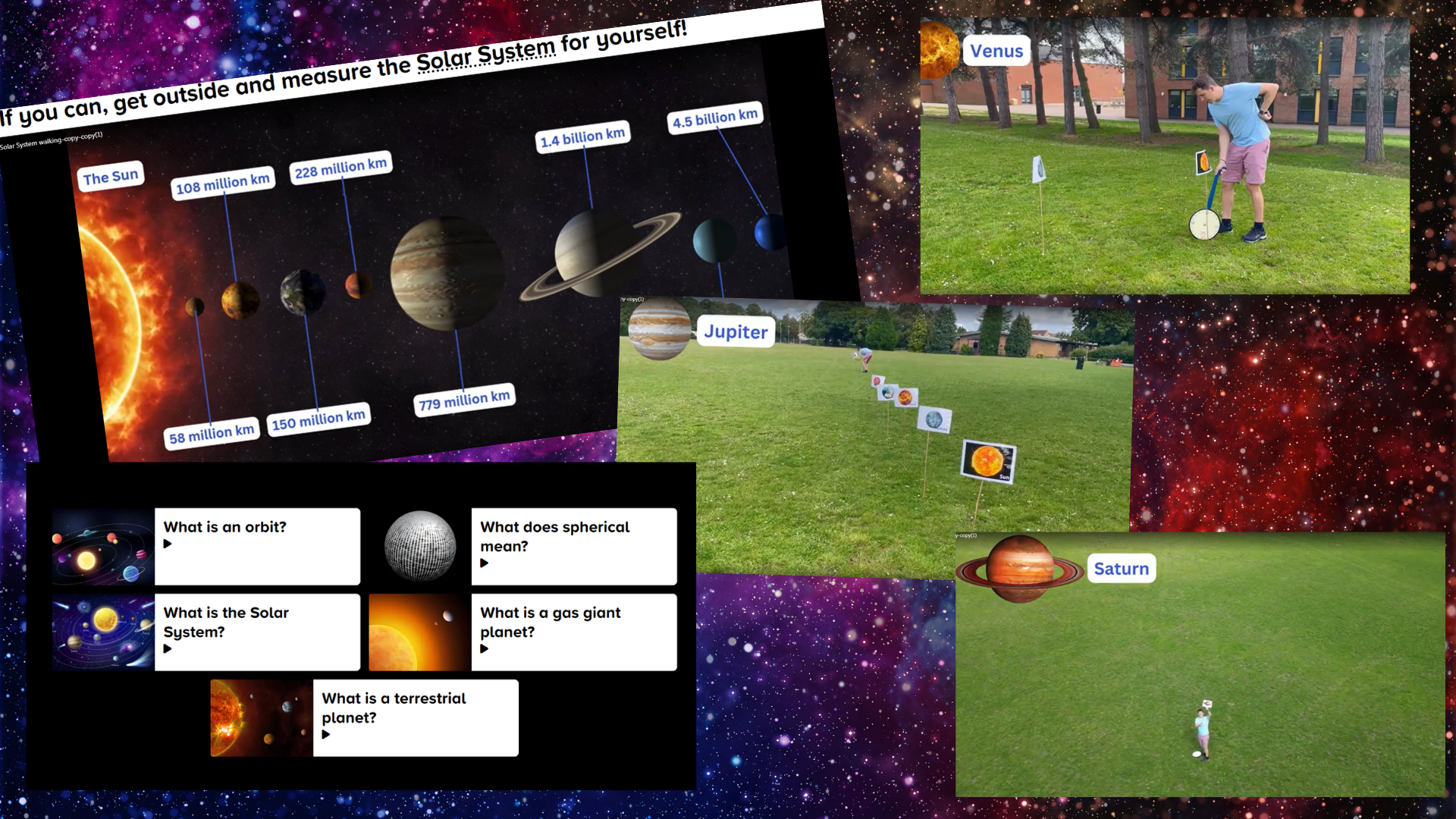
Progression from KS2 to KS4. Key topics come back at greater depth as students move through school. Space is a good example. Students meet the Solar System in Year 5 Earth and Space, explore gravity and the scale of the wider universe in KS3 Space, then move on to the life cycle of stars and the beginnings of the universe in KS4 Space. Electricity follows a similar path, from Year 4 and Year 6 into KS3 Electricity and Magnetism. At each stage, students build the reasoning, data analysis and scientific vocabulary that GCSE will ask of them, whether they go on to Combined or Separate Science.
Practical work at the centre. At KS3, investigations become more structured and independent, with students planning enquiries and interpreting results for themselves. Along the way, they separate inks using chromatography, dissect a flower, investigate Hooke's Law, test foods for nutrients, build an electromagnet and measure the speed of sound on the school field.
How science works. Students find out how Mendeleev organised the elements and how Watson, Crick, Wilkins and Franklin developed the model of DNA. They see how scientific ideas are built, tested and changed over time.
Real scientists in lessons. Lessons feature people working in science and engineering today, from electrical engineers to botanical specialists. Students see where their learning could take them, which matters at exactly the age they start to find their passions.
You don't need to wait for the consultation to start thinking about KS3 science.
When will the revised National Curriculum be published?
The first look at the revised curriculum is expected to go out for public consultation by the end of 2026, with the final version to follow. First teaching is planned for September 2028.
Does this mean no GCSE content before Year 10?
The expectation is that schools won't start GCSE specifications early for whole cohorts, narrow students' options early or enter them for exams ahead of time. KS3 can still prepare students well for GCSE by building secure foundational knowledge and skills.
Can schools still stretch high-achieving students?
Yes. Teachers keep the flexibility to stretch students or groups who are ready to go further, as long as their options aren't narrowed as a result.
If the reforms work, the question of what Year 9 science is for should be as easy to answer as it is for Year 11. It's where students get the fundamentals secure, find out what science can do and decide it's worth sticking with.
If you're new to Developing Experts, you can explore our KS3 science curriculum, along with our full Science, Geography and History offer, with a free two-week trial. Simply visit www.developingexperts.com to sign up today.
Address
Developing Experts Limited
Exchange Street Buildings
35-37 Exchange Street
Norwich
NR2 1DP
UK
Phone
01603 273515
Email
[email protected]
Copyright 2026 Developing Experts, All rights reserved.

Unlock expert-designed lessons, resources, and assessments tailored for educators. No credit card required.
Claim Your Free Trial →We use cookies to enhance your browsing experience and analyze our traffic. Learn more.