





Creating Career Path...

Finding Further Careers...

Acoustic Engineer

View this career for different education levels:

Imagine you are listening to your favourite song or trying to hear your teacher in a noisy classroom. An Acoustic Engineer is like a sound detective and designer! They work with sound and vibrations to make things sound better, quieter, or even safer. They might help design concert halls so the music sounds amazing, or make sure noisy machines in a factory dont harm peoples ears. They use special tools to measure sound and think about how sound travels, bounces, and changes. It is a bit like playing with sound waves to get them to do what you want them to do. They could be working on many different projects. For example, they might help design a new building to keep out traffic noise, or make sure the speakers at a big event sound just right. They also help to make sure that the sounds from things like aeroplanes or trains are not too loud for people living nearby. It is a really interesting job that combines science, maths, and a bit of creativity to make the world a better sounding place!

Acoustic Engineer

Flag Media

Please select a reason for flagging this content.

📊 Statistics

Starting Salary

A new Acoustic Engineer in the UK might start with a salary of around 25,000 to 30,000 pounds a year.

Experienced Salary

With more experience, an Acoustic Engineer could earn between 35,000 and 55,000 pounds or more a year.

Number of Jobs

There are hundreds of Acoustic Engineer jobs in the UK, with new ones appearing often as companies need help with sound.

🚀 Careers in this path

Flag Media

Please select a reason for flagging this content.

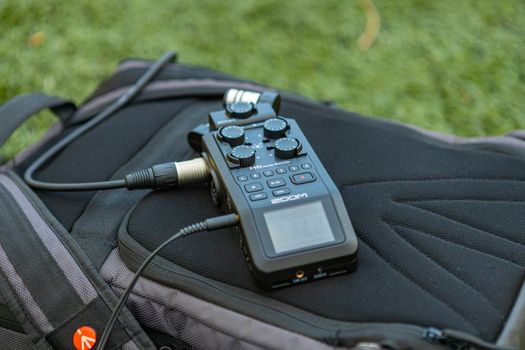
Sound Recorder for Nature

Imagine going into forests or by the sea with special microphones to record all the amazing sounds of birds, animals, and waves. You'd help make nature documentaries sound super real!

Flag Media

Please select a reason for flagging this content.

Game Sound Designer

Do you love computer games? A Game Sound Designer creates all the exciting sounds you hear, like character voices, magical spells, or the whoosh of a spaceship. You'd make games sound awesome!

Flag Media

Please select a reason for flagging this content.

Music Studio Helper

If you love music, you could help in a music studio. You'd learn how to set up microphones, adjust the sound levels, and make sure the music sounds perfect for the singers and musicians.

Learning About Sound

Listen Carefully

Start by listening to all the different sounds around you. Can you tell where they come from? Are some loud and some quiet?

Pay attention to the sounds in your home, at school, and outside. Notice how sounds can change depending on where you are. A bell might sound different in a big hall compared to a small room. Thinking about these differences is the first step to understanding sound.

Explore Music

Music is all about sound! Try playing different musical instruments or listening to various types of music. How do they make different sounds?

You could try making your own simple instruments, like shakers or drums, to see how different materials create different sounds. Learning to play an instrument, even just a recorder, can help you understand pitch, rhythm, and how sounds combine.

Science Fun

Science lessons at school are great for learning about how things work, including sound. Ask your teacher about sound experiments!

In primary school, you might learn about vibrations and how they make sound. You can do simple experiments at home too, like plucking a rubber band to see it vibrate and hear the sound it makes. Learning these basics helps you understand the building blocks of acoustic engineering.

Building Your Skills

Good at Maths

Maths helps you understand patterns and measure things, which is important for working with sound waves.

As you get older, maths becomes very important for an Acoustic Engineer. It helps them calculate how sound travels, how loud it is, and how to stop unwanted noise. Practising your numbers and problem-solving now will make later maths easier and more fun.

Computing Skills

Computers are used by Acoustic Engineers to design and test sound. Learning to use them now will be very helpful.

Acoustic Engineers use special computer programmes to draw plans, simulate sound, and analyse data. Learning to type, use drawing programmes, and understand how computers work will give you a head start. Even playing educational computer games can help you get comfortable with technology.

Learn About Physics

Physics is the science of how things move and work. Sound is all about physics!

In secondary school, you'll learn more about physics, which includes topics like waves, energy, and vibrations. These are the core ideas behind how sound works. Paying attention in physics classes and asking questions will be very beneficial for this career path.

Next Steps for Grown-Ups

Study at College or University

After school, you'd go to college to study subjects like Maths and Physics, and then maybe university for an engineering degree.

To become an Acoustic Engineer, you would typically need to get good grades in subjects like maths and physics at A-level (or equivalent). Then, you'd apply to university to study a degree such as Acoustics, Acoustical Engineering, or a broader engineering degree with a specialism in acoustics. There are many great universities in the UK offering these courses.

Get Work Experience

Trying out a job for a short time helps you see what it's really like and learn from experienced engineers.

During your university studies or after, try to find internships or work placements with engineering companies that work with sound. This hands-on experience is invaluable for understanding how theory is applied in real-world projects, whether it's designing concert halls, developing quieter products, or reducing noise pollution.

Start Your Career

Once you have your qualifications and experience, you can apply for jobs as an Acoustic Engineer!

With a degree in acoustics or a related engineering field, and some practical experience, you'll be ready to apply for junior Acoustic Engineer positions. You could work in many different areas, such as architectural acoustics, environmental noise control, product design, or even in the music industry. There are also professional bodies like the Institute of Acoustics that you can join for continued learning and networking.

🎬 Useful Videos

🎯 View Apprenticeships

Explore relevant apprenticeships that can help you kickstart your career in Acoustic Engineer. Apprenticeships offer hands-on experience and training while earning a wage.

Career Progressions

No career progressions found for Acoustic Engineer

Sample Qualifications

An Acoustic Engineer designs and implements solutions for sound and vibration issues, which directly aligns with the role of an Acoustics consultant who provides expert advice and solutions in acoustics.

How to become

You can get into this job through:

  • a university course
  • working towards this role

University

Most employers will expect you to have a degree in a subject like:

  • acoustics
  • maths
  • physics
  • engineering

You could do a degree in music technology or environmental science, followed by further training in acoustics or applied acoustics at postgraduate level.

The Institute of Acoustics also offers the Diploma in Acoustics and Noise Control, which can help towards gaining membership of the Institute.

Entry requirements

You'll usually need:

  • 5 GCSEs at grades 9 to 4 (A* to C), or equivalent, including English, maths and science
  • 2 or 3 A levels, or equivalent, including maths and physics
  • a degree in a relevant subject for postgraduate study

More Information

Work

You may be able to start work as an assistant or trainee acoustics technician and with further training, qualify as an engineer or consultant.

You'll normally need at least 4 GCSEs at grades 9 to 4 (A* to C), including two science subjects. A levels or equivalent, like applied science, may be acceptable. Employers may also consider relevant work experience, for example, in non-destructive testing, if you do not have sufficient academic qualifications.

More Information

Professional and industry bodies

You can join the Institute of Acoustics for professional development opportunities and to make contacts in the industry.

Further information

You can find out more about a career as an acoustics consultant from the Institute of Acoustics.

Interested in More Career Paths?

Explore other careers or use our AI to discover personalised paths based on your interests.

Stay connected

Join our newsletter to stay up to date on features and releases

Address
Developing Experts Limited
Exchange Street Buildings
35-37 Exchange Street
Norwich
NR2 1DP
UK

Phone
01603 273515

Email
[email protected]

Copyright 2026 Developing Experts, All rights reserved.
