A quick guide to our exclusive Science Week 2026 lessons.

British Science Week is the perfect annual opportunity to focus on enquiry and let pupils think and work like scientists. Every year at Developing Experts, we release exclusive Science Week-themed resources that engage with the chosen topic, and this year is no different. The British Science Week theme is ‘Curiosity: what’s your question?’, which we will be exploring through our unifying theme built around bubbles. This year's activities provide a coherent journey from EYFS to KS3, developing scientific reasoning and questioning step by step.
This year, British Science Week 2026 is held from the 6th to the 15th of March. Preparing early will help you make the most of the learning opportunities on offer. With that in mind, we’ve prepared a starter guide on what you can expect from our EYFS-KS3 lessons, including the resources you’ll need to have on hand. Read on to find out more.
The strength of our Science Week content lies in how a single, relatable concept evolves across year groups. Bubbles are both familiar and engaging for pupils, making them an ideal vehicle for exploring working scientifically at every stage.
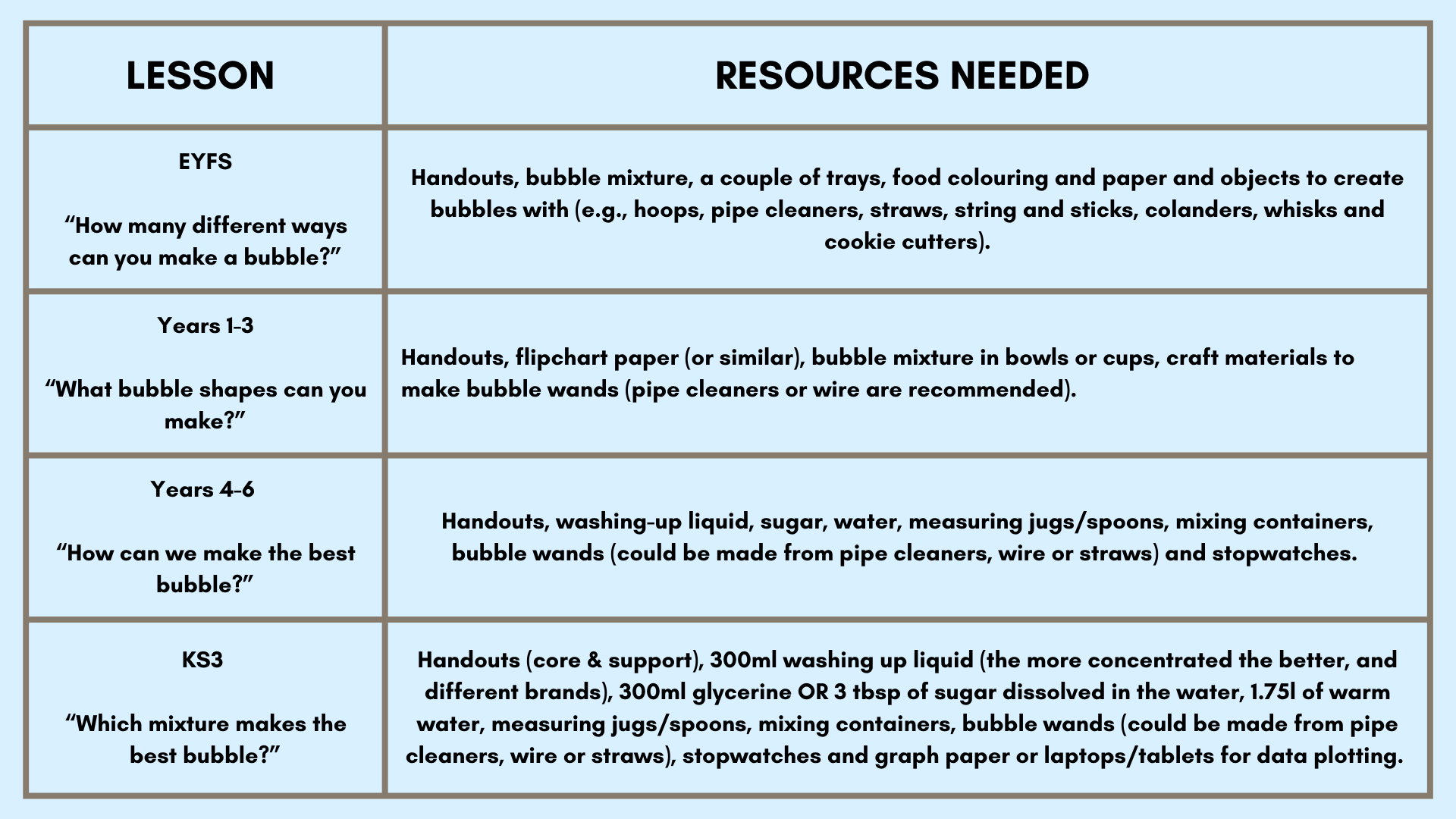
Our central question: “How many different ways can you make a bubble?”
Resources needed: Handouts, bubble mixture, a couple of trays, food colouring, paper and objects to create bubbles with (e.g., hoops, pipe cleaners, straws, string and sticks, colanders, whisks and cookie cutters).
What the lesson covers: Through discussions and shared vocabulary, the children will look at colours, patterns, sizes and shapes. They’ll use trays of bubble mixture and different everyday objects to explore what bubbles look like, how they are made and how they behave.
Our central question: “What bubble shapes can you make?”
Resources needed: Handouts, flipchart paper (or similar), bubble mixture in bowls or cups, craft materials to make bubble wands (pipe cleaners or wire are recommended).
What the lesson covers: Using simple equipment such as pipe cleaners or wire, pupils design their own bubble wands and predict the shapes they think their bubbles will form. They then test their ideas, recording observations through drawings, tables and simple conclusions that are carefully scaffolded to support different levels of independence.
This activity engages with key areas of working scientifically, such as making predictions, following a method and using results to answer a question.
Our central question: “How can we make the best bubble?”
Resources needed: Handouts, washing-up liquid, sugar, water, measuring jugs/spoons, mixing containers, bubble wands (could be made from pipe cleaners, wire or straws) and stopwatches.
What the lesson covers: Here, pupils will work scientifically to identify variables, write a clear method and decide how results should be measured. Rather than relying on vague ideas of ‘best’, pupils should agree that bubble lifespan is the most reliable, measurable criterion.
As always, we encourage pupils to think beyond the classroom. This lesson explores the application of bubbles in industries relating to glass blowing, fire-fighting foams, detergents and food science.
Our central question: “Which mixture makes the best bubble?”
Resources needed: Handouts (core & support), washing-up liquid (different brands), glycerine and sugar, water, measuring jugs/spoons, mixing containers, bubble wands (could be made from pipe cleaners, wire or straws), stopwatches and graph paper or laptops/tablets for data plotting.
Quantities for the control mixture for the whole class:
What the lesson covers: At KS3, pupils build on prior learning with greater independence and precision. The investigation into bubble mixtures becomes a fully developed enquiry, incorporating hypothesis writing, repeat readings, data plotting and evaluation of reliability.
Students compare different brands and additives such as glycerine and sugar, considering how factors like surface tension, viscosity and evaporation affect results. They are encouraged to justify their hypotheses using scientific terminology and reflect critically on anomalies and limitations in their methods.
By planning ahead and seeing how learning progresses from EYFS to KS3, you can ensure that Science Week feels purposeful, coherent and aligned with your pupils’ interests and abilities. If you’re looking to make Science Week 2026 manageable and firmly rooted in the curriculum, starting preparation now is the best first step.
Resources for Science 2026, including lesson plans and presentations, will be available from the 13th of February. We also have guide videos for how to make bubble wands and our bubble mixture!
If you already have an account with Developing Experts, you can access our resources and lesson plans when they’re released in your unit library. If you’re new to our platform, it’s easy to set up an account to access our Science Week resources. You can do so by visiting www.developingexperts.com today.
Address
Developing Experts Limited
Exchange Street Buildings
35-37 Exchange Street
Norwich
NR2 1DP
UK
Phone
01603 273515
Email
[email protected]
Copyright 2026 Developing Experts, All rights reserved.

Unlock expert-designed lessons, resources, and assessments tailored for educators. No credit card required.
Claim Your Free Trial →We use cookies to enhance your browsing experience and analyze our traffic. Learn more.

