This blog explains the key findings of the OECD's PISA 2025 report, how PISA measures scientific literacy, and what the results mean for science teaching.

Estimated read time: 5-6 minutes
The OECD's PISA 2025 results are in. Last year, more than 760,000 students across 91 countries sat the same assessment. PISA 2025 put science at its centre for the first time in a decade, and of the three core subjects it has proved the most resilient. Even so, average scores slipped in most participating countries. However, the UK was one of the few where they rose.
The full report runs to nearly 400 pages, so here are the findings worth your time, why PISA's definition of science will look familiar to anyone who teaches working scientifically, and how our curriculum already builds the skills it measures.
PISA 2025 revealed the lowest average levels of performance yet observed across OECD countries in the three core subjects. But the three have moved very differently over the past decade. Science fell from 489 to 482 points between 2015 and 2025 - a modest drop, and the most resilient of the three. Mathematics fell from 485 to 463, roughly the equivalent of a year of learning. Reading fell furthest, from 489 to 461.
Across the OECD, 20% of 15-year-olds are now low performers in all three subjects at once, up from 16% in 2022. In science, that means struggling to interpret simple data or identify the evidence in a graph. Reading declined most sharply in the skills that carry the most weight elsewhere: evaluating information, connecting ideas across multiple sources, and thinking critically about what you read. One figure stands out: the share of "hasty readers", students who rush through a text and give quick but incorrect answers, almost doubled between 2018 and 2025. That matters well beyond English lessons, as countries with the largest declines in reading also tended to record the largest drops in mathematics and science.
It would be easy to read this as pandemic fallout, but reading peaked around 2012, and mathematics fell most sharply after 2018. The OECD points to deeper, longer-running challenges in education systems, not a dip that recovery time will fix on its own.
Against that backdrop, the UK result stands out. The UK placed in the global top 10 across all three domains, alongside Singapore, Japan, Korea, Estonia, Chinese Taipei and several Chinese jurisdictions.
One area the report highlights is gender. In the UK, boys outperformed girls by 12 points in science, where the OECD average gap is close to zero, and by 24 points in mathematics against an OECD average of 13. This is a clear reminder that strong overall performance can sit alongside gaps still worth closing.
PISA defines scientific literacy through three kinds of knowledge:
Alongside these sit three competencies: explaining phenomena scientifically, evaluating how enquiries are designed and interpreting data critically, and using scientific information to make decisions.
There is a striking overlap with working scientifically in the National Curriculum: PISA asks pupils not only to know scientific ideas, but to evaluate enquiries, interpret evidence and understand how scientific claims are justified.
The third strand is the one most easily squeezed out when time is short, and it's the one the report dwells on. Encouragingly, 81% of students globally already hold sound beliefs about how science works: that good answers rest on evidence from many experiments, that a source should be checked against others before it's accepted, and that discoveries change what scientists think is true.
The OECD draws several conclusions of its own:
How Can Developing Experts Help?
Developing Experts’ science curriculum was built around many of the same principles highlighted by PISA 2025: coherent sequencing, explicit scientific enquiry and opportunities for pupils to apply knowledge rather than simply recall it.
Enquiry is named in every primary lesson. Alongside the National Curriculum reference, each lesson states its scientific enquiry focus - planning enquiries and controlling variables, taking repeat readings with increasing accuracy, recording results in tables, scatter graphs and line graphs. These are the kinds of procedural knowledge PISA assesses, taught explicitly from Year 1 rather than left to chance.
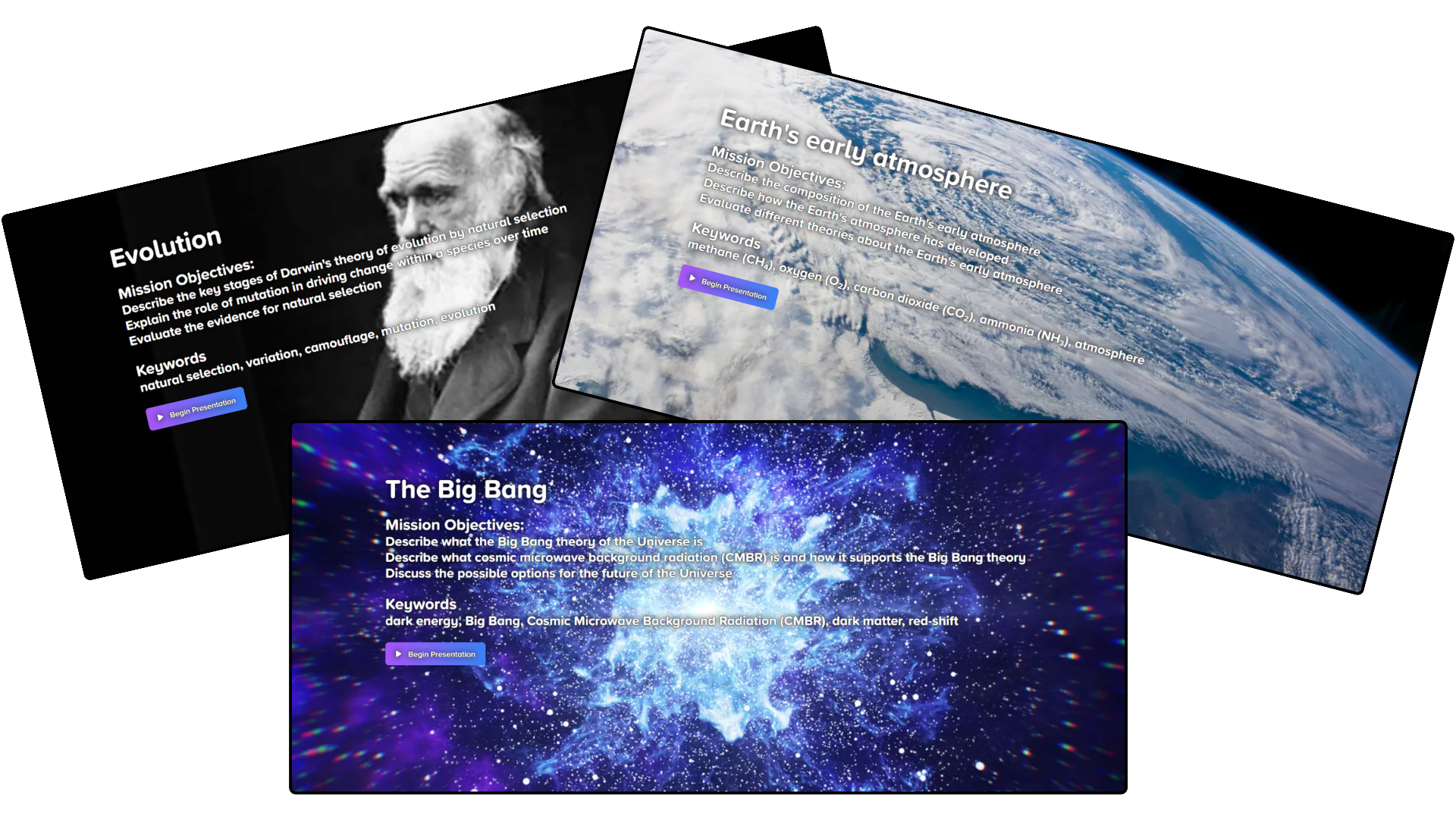
The epistemic strand is taught deliberately. Identifying the evidence used to support or refute an argument recurs throughout our curriculum. In Key Stage 2, pupils weigh the historic case for the geocentric and heliocentric models of the Solar System, examine what fossils can tell us about life on Earth, and explore how Darwin arrived at natural selection. At Key Stage 3 and 4, it continues into peer review and how theories change when new data arrives, resourced in full with lesson plans, presentations, retrieval activities and filmed required practicals at GCSE. You can find some great examples of this in our KS4 lessons on ‘Evolution’, ‘Earth’s Early Atmosphere’ and ‘The Big Bang’.
Data interpretation gets its own lessons. For example, in Year 6, ‘Explore how data can demonstrate climate change’ has pupils work with real historical temperature and rainfall data, drawing on all four scientific enquiry strands at once. It sits within our six-lesson ‘Looking after the Environment’ unit.
On the gender gap: Our Expert and Career Films regularly feature female presenters from across STEM industries, so pupils see who does this work as well as what the work involves.
You'll find everything in our Science, Geography and History curricula, and you can explore it all with a free two-week trial at www.developingexperts.com.
A Strong Position Worth Protecting
The UK's results are encouraging at a time when performance has fallen across much of the OECD. But PISA 2025 also offers a clear message about what strong science education needs: depth over breadth, coherent sequencing, curious pupils and an understanding not only of what science knows, but how science knows it.
Address
Developing Experts Limited
Exchange Street Buildings
35-37 Exchange Street
Norwich
NR2 1DP
UK
Phone
01603 273515
Email
[email protected]
Copyright 2026 Developing Experts, All rights reserved.

Unlock expert-designed lessons, resources, and assessments tailored for educators. No credit card required.
Claim Your Free Trial →We use cookies to enhance your browsing experience and analyze our traffic. Learn more.