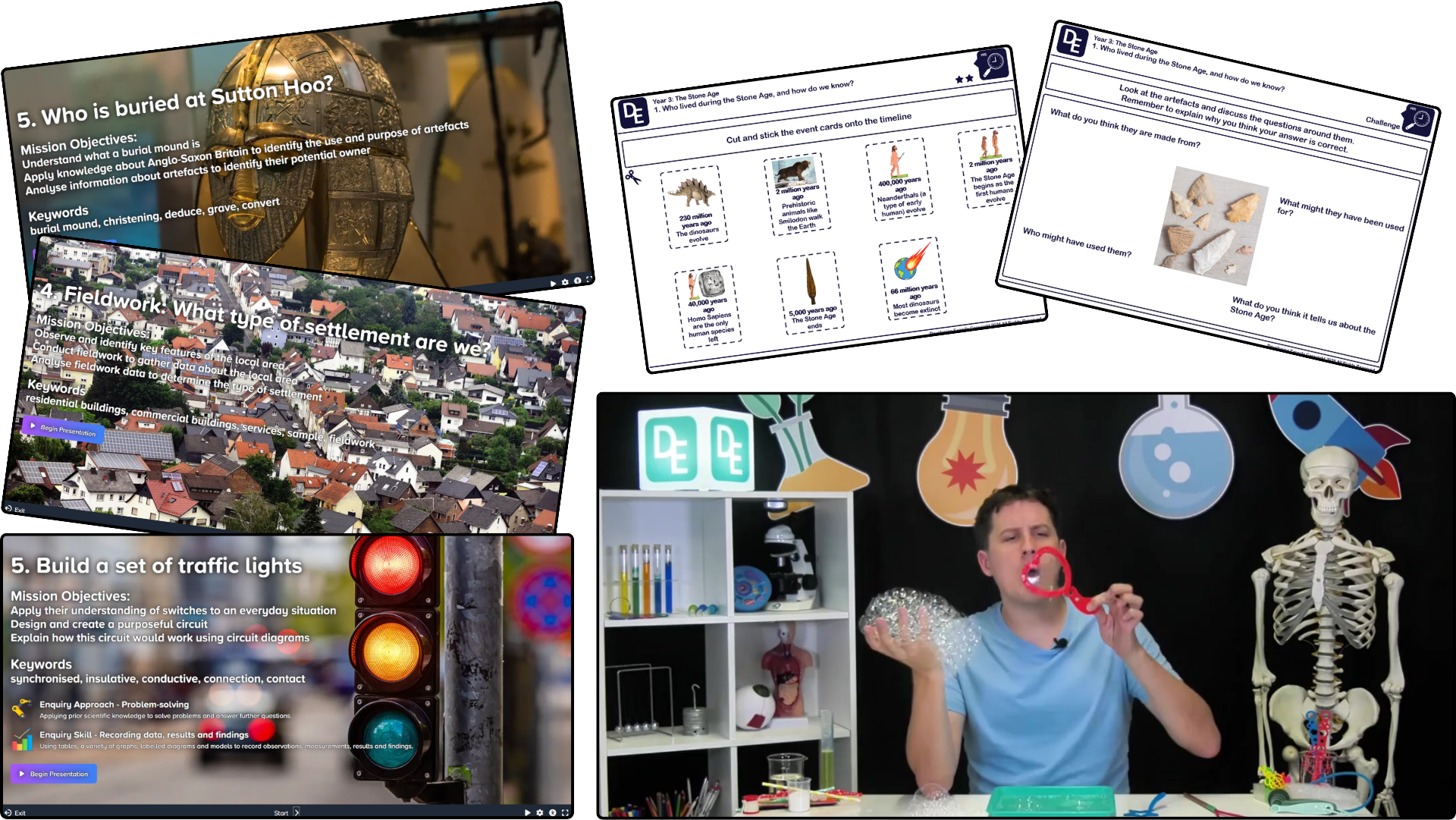
This blog explains what is known about the Curriculum and Assessment Review while the consultation on draft programmes of study remains unpublished, what it means for science, geography and history, and what Developing Experts is building in response.

Estimated read time: 5 minutes
We’re still waiting for the consultation on draft programmes of study, which was expected in September.
If you’re teaching next week’s lessons, that doesn’t change much. But if you’re a subject lead trying to map a curriculum for 2028, it matters a lot.
The good news is that the direction is already clear. The final review report landed in November 2025, and the government accepted most of its recommendations, so the broad shape of the new curriculum has been visible for some time. Schools don't have to wait for the consultation to start thinking.
The review asks for science education grounded in the fundamental concepts of each discipline, with more cohesion and consistency across the primary curriculum. It calls for climate change and sustainability to be taught explicitly, and for the purpose and expectations of high-quality practical work to be articulated far more clearly than they are now.
At secondary, the review recommends an entitlement to Triple Science at GCSE, ensuring that every student who wants to study it has the opportunity to do so, recognising its value for future study and careers. There's also a proposed change to Progress 8 that would give Science two dedicated slots, increasing its weighting within school performance measures and bringing its representation more in line with English and maths. If that happens, it would strengthen the position of science in curriculum planning considerably.
Here the recommendation is for refinements rather than wholesale change: streamlining the programmes of study, removing unnecessary repetition and strengthening progression across key stages. For primary geography, the review also points towards making climate change and sustainability more explicit, and reinforcing the role of fieldwork in helping pupils investigate the world around them.
The more significant shift is at Key Stage 3, where the review calls for a sharper focus on disciplinary knowledge. That means geographical enquiry, spatial reasoning, the use of digital tools and geographical evidence, taught as the ways geographers investigate and understand the world, rather than simply as content to be covered.
The review asks for the history programmes of study to be adjusted so that disciplinary knowledge and skills are improved and applied more explicitly. In practice, that means primary pupils understanding where our knowledge of the past comes from and how reliable a source is, rather than only learning what happened.
The review also calls for greater support for teaching the diversity inherent in history, including through a wider range of sources and, where appropriate, local history. This would help pupils explore the complexity of Britain's past and its connections with the wider world, while broadening their understanding of different people, experiences and perspectives.
One recommendation would affect every subject. The review proposes an oracy framework to sit alongside existing literacy frameworks, driven by evidence that speaking, listening and communication matter for learning, critical thinking and engagement.
The expectation is that oracy becomes a thread running through the whole curriculum rather than something confined to English lessons. For most schools, this won’t mean adding something new, but recognising and structuring the talk that already happens in their classrooms.
You can find out more about all of this in more detail in our previous blogs:
We're not waiting for the consultation either. Four things are underway:
A complete review of our curricula
Every unit and lesson from EYFS to KS4 is being reviewed against the direction the new framework is taking. Where the detail isn't settled yet, we're working on the parts that are.
New lessons and resources
The review is a chance to rebuild rather than patch, and we're writing new material as part of it instead of only adjusting what exists.
A stronger inclusion offer
The review's principle of a curriculum for all is one we take seriously, and it's the area we're investing most heavily in. We're working with inclusion specialists and teachers to ensure our resources work for every pupil in the room. You can see our current SEND adaptation tools on the platform.
Oracy throughout
This one is already well advanced. Oracy has been at the front of our thinking during our ongoing science review and while writing our new geography and history curricula, and our lesson plans and mission assignments are being built with opportunities for talk designed in rather than bolted on.
You can start on all of this without waiting for the consultation:
When will the new National Curriculum be published?
A revised National Curriculum is expected in 2027, with the consultation on draft programmes of study and subject content coming first. That consultation was expected in September and has not yet been published.
When does the new curriculum come into force?
First teaching is planned for September 2028.
What does the Curriculum and Assessment Review change for science, geography and history?
Science gets a sharper focus on disciplinary concepts, explicit climate and sustainability content, and clearer expectations for practical work. Geography sees streamlined content and stronger disciplinary knowledge at Key Stage 3. History gets a clearer emphasis on how we know about the past, and on the diversity of British history.
What should schools be doing while they wait?
Auditing current provision is the most useful thing. Oracy, climate and sustainability, cross-curricular coherence and the purpose of practical work are all areas the review highlights, and all can be reviewed without the final detail.
The consultation will come. When it does, schools will have less time to prepare than anyone would like, which makes the thinking you do now more valuable rather than less.
If you're new to Developing Experts, you can explore all our content, including lessons in Science, History and Geography, with a free two-week trial. Simply visit www.developingexperts.com to sign up today.
Address
Developing Experts Limited
Exchange Street Buildings
35-37 Exchange Street
Norwich
NR2 1DP
UK
Phone
01603 273515
Email
[email protected]
Copyright 2026 Developing Experts, All rights reserved.

Unlock expert-designed lessons, resources, and assessments tailored for educators. No credit card required.
Claim Your Free Trial →We use cookies to enhance your browsing experience and analyze our traffic. Learn more.