Discover the thinking behind the Primary History Curriculum through our Design and Approach Document. Covering Intent, Implementation, and Impact, this guide explains how the curriculum develops historical knowledge, enquiry skills, and meaningful learning experiences, while providing practical support for teachers.

Developing Experts’ (DE) KS1 and KS2 history curriculum aims to inspire pupils to become inquisitive historians who develop a coherent understanding of the past as they progress through their primary education. Chronological awareness and critical thinking form the foundation of a curriculum that gives pupils the disciplinary skills to think like historians and the substantive knowledge to draw conclusions about key individuals, people and events from both the ancient world and more recent times. Building curiosity and deeper thinking is at the core of our approach, and we strive to support pupils in developing a lifelong love of history through diverse and engaging learning.
As with all curricula supplied by DE, our history resources are fully aligned to the National Curriculum. With an emphasis on transferable skills, such as evaluating and analysing content, learners can apply their understanding in real-life contexts, including through oracy forms such as debate and presentations. These skills equip learners with the knowledge and experience to support the next stage of their education.
Our lessons allow pupils to explore historical narratives from several perspectives, ensuring the knowledge they build is diverse. Through our carefully sequenced enquiry questions and knowledge-rich lessons, pupils learn to analyse evidence, understand cause and consequence and consider why some events, people and civilisations retain their historical significance into the present day.
DE’s history curriculum is focused on the key aims laid out in the National Curriculum. Based on this, DE’s ambitious curriculum allows pupils to develop the following:
From KS1, historical understanding is built through careful exploration of the passage of time, change and continuity. Core themes, such as the significance of people, events and time periods, build the foundations of historical knowledge and disciplinary skills, which are further developed through KS2.
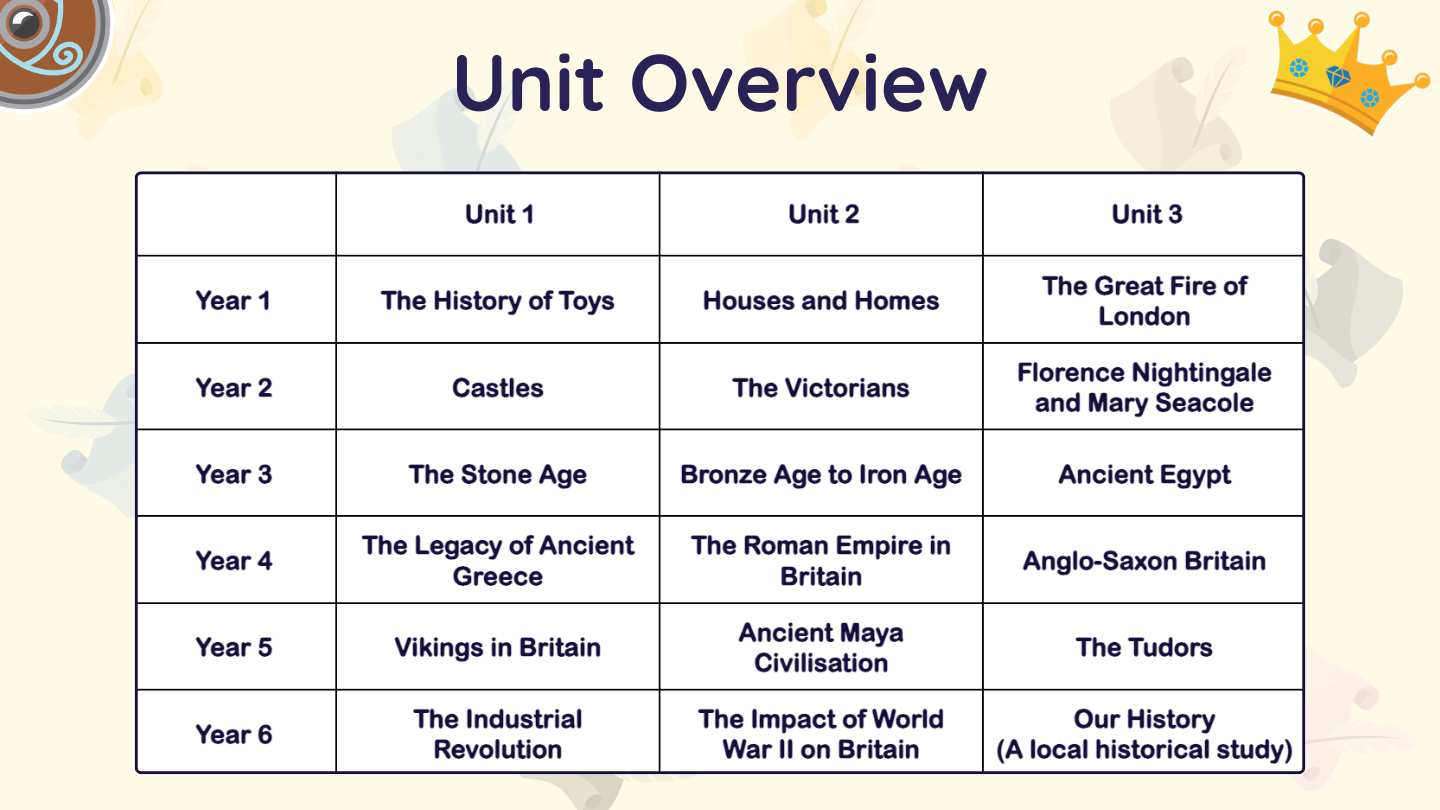
Our curriculum is organised chronologically to support pupils in building their understanding of key events and time periods in Britain and the wider world. From Year 3, we use BCE/CE (Before Common Era/Common Era) when referring to dates, rather than BC/AD (Before Christ/Anno Domini), as this is a modern, non-religious convention commonly used by historians. However, reference is made to both dating systems throughout KS2 so that they can recognise and understand dates presented in either format.
Our curriculum explores topics in depth, and learning is revisited and progressively built upon. In alignment with the Ofsted Education Inspection Framework, our curriculum is designed to help pupils “remember in the long term the content they have been taught”. Using DE’s spiral approach, pupils revisit and revise key learning points before developing new knowledge, both within and across units. Concepts and core themes have all been selected to ensure a broad range of historical areas are covered, such as social, cultural, political & military history. Our curriculum has been designed to embed a broad range of substantive knowledge in pupils, which will allow them to deepen and extend their understanding in their later education.
Every DE history unit includes:
DE’s presentations are knowledge-rich, containing a diverse array of media such as images, videos, question prompts and animations. Independent tasks provide engaging and exciting opportunities for extended writing and the development of oracy skills.
DE’s history curriculum fosters critical and inquisitive thinking while providing historical knowledge with meaningful context. It enables pupils to develop both disciplinary and substantive historical understanding, building knowledge and skills progressively throughout the primary curriculum. Pupils learn to apply these skills to new situations, exploring cause, consequence, and change to make sense of the world around them. This approach gives depth and relevance to the present day, helping pupils connect past events to contemporary life.
This last unit of our sequenced curriculum forms the cumulative end of the pupils’ primary learning and celebrates everything they have learned throughout their history education. It allows pupils to showcase their historical knowledge and skills by producing a project about the history of their local area. This also fulfils the National Curriculum requirement for pupils to undertake a local history study. This final unit is a demonstration of each pupil’s curiosity and critical thinking that has been nurtured through their time in primary school.
DE’s history lessons do not require schools to obtain any specialist equipment. However, we recommend that teachers contact local museums to enquire about primary sources and artefacts that can be loaned to your school for use within lessons.
There are areas of the curriculum in which teachers may wish to arrange a visit to a historical site linked to the unit. In particular, DE recommends that pupils visit a local historical site to further support the Our History unit. In addition, in Year 1, Houses and Homes, it is recommended that pupils have the opportunity to explore buildings that are local to the school site.
Lastly, DE recommends that schools have access to digital mapping tools, particularly those that demonstrate how land use has changed over the decades.
Address
Developing Experts Limited
Exchange Street Buildings
35-37 Exchange Street
Norwich
NR2 1DP
UK
Phone
01603 273515
Email
[email protected]
Copyright 2026 Developing Experts, All rights reserved.

Unlock expert-designed lessons, resources, and assessments tailored for educators. No credit card required.
Claim Your Free Trial →We use cookies to enhance your browsing experience and analyze our traffic. Learn more.

