Firework safety and dark nights: classroom activities to help pupils stay safe after dark, plus primary science units on light, shadows and day and night.

Estimated read time: 6 minutes
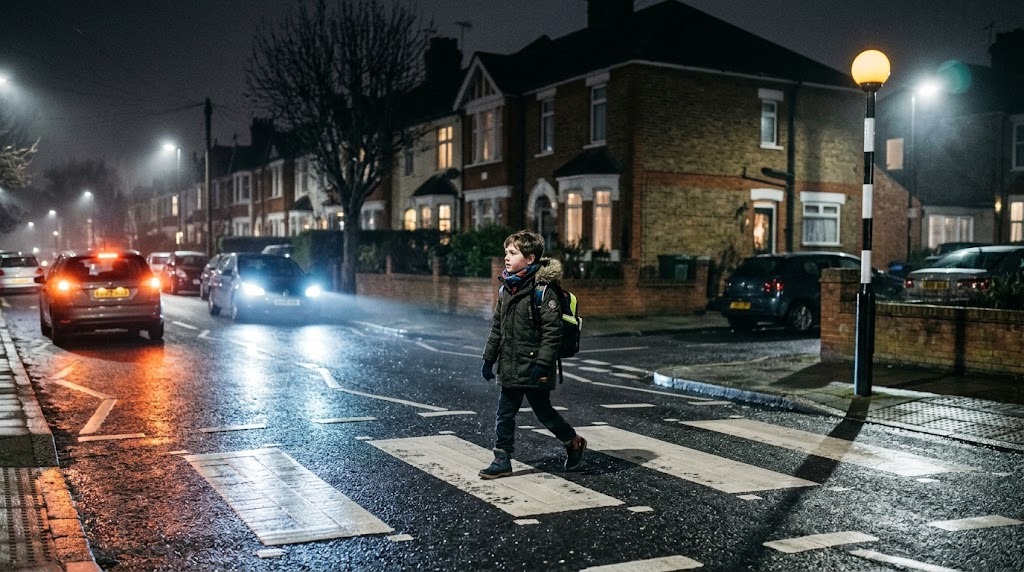
The clocks go back at the end of October, and suddenly the school day finishes in the half-dark. Pupils who walked home in sunlight a fortnight ago are now crossing roads in gloom, in navy coats, on pavements lit by whatever happens to be nearby.
It's also the time of year when children are out after dark for the fun of it. Bonfires, fireworks, celebrations, family gatherings that run well past bedtime. For a lot of pupils, the next few weeks are the only time all year they're outside in the evening in a crowd.
This all makes late autumn a useful teaching moment, as the science of light and dark stops being ‘just a lesson’ and becomes something children need on the walk home.
Children assume that if they can see a car, the driver can see them. Most won’t work out why that’s wrong unless someone shows them.
Pupils need to understand that we see objects because light reflects off them and into our eyes, and a child in a dark coat on an unlit pavement is reflecting almost nothing. Showing them by using a torch and a dark corner of the classroom does more for road safety than any number of reminders to be careful.
Fireworks add another layer at this time of year. They're loud, bright and unfamiliar, and most children only encounter them a handful of times before they're old enough to handle them sensibly. Calm conversations in school throughout this season tend to stick better than anything said in the middle of the excitement.
Whether you've got ten minutes or a full afternoon, these work across the primary age range:
• Test reflective materials. Darken a corner of the classroom, shine a torch at a range of fabrics and surfaces, and get pupils to rank them by how much light bounces back. You could explore high-vis strips, white cotton, black wool, foil, or a bike reflector. Most pupils are surprised by how little comes back off dark fabric.
• Run a "can you see me?" investigation. On the playground, one pupil stands in a dark coat and another in something light or reflective. Walk backwards and record the distance at which each becomes hard to spot.
• Design a reflective accessory. A badge, armband, bag tag or zip pull. Pupils apply what they've learned about reflection and have something to take home, which gets the message to families too.
• Investigate shadows and silhouettes. Why does someone in dark clothing standing in front of a bright shop window turn into a silhouette? Good for exploring how light travels and how our eyes handle contrast.
• Write a safety guide for families. A leaflet, poster or short film aimed at younger siblings. Explaining something to someone else is one of the best ways to remember it.
• Sequence the firework code. Cut the key rules into strips and get pupils to put them in order, then justify the order they chose.
• Talk through sparklers properly. They look harmless, but they aren't. A lit sparkler burns far hotter than boiling water and stays hot long after it stops sparkling. Share the rules: gloves on, held at arm's length, never run while holding one, and straight into a bucket of water or sand when they go out.
• Make a "spot the hazard" picture. A busy evening scene with ten things wrong in it. Ask pupils to find them and explain why each one is important.
Pupils learn that they need light in order to see, that dark is the absence of light, and how light reflects from different surfaces. It's the foundation for everything about being seen after dark, and Year 3 is around the age when some children start making more of their journeys independently.
Here, pupils explore how light travels in straight lines and how we see objects because light reflects from them into our eyes. Applied to a dark pavement or a crowded display, the physics of light becomes much more meaningful.
Our Year 5 unit explores day and night and the passage of time through the Earth's orbit and rotation, which answers the question sitting behind all of this: why are the evenings suddenly so dark, and why does it happen at the same point every year? Our Space Week blog has more ideas for teaching the Solar System.
A good partner for this time of year, as pupils learn how quickly fire spread through seventeenth-century London, why it took hold and what changed afterwards. Treating fire with respect becomes a story with consequences rather than an instruction.
For our youngest pupils, an introduction to the celebrations that happen across the UK through the year and the different ways people mark them. A gentle way into talking about staying close to a grown-up when everything is loud, dark and exciting.
Most children will be fine - they'll go out, enjoy themselves and come home. But the few minutes it takes to explain why a dark coat disappears at dusk, or why a sparkler stays dangerous after it stops sparkling, are minutes well spent.
If you're new to Developing Experts, you can explore all of our science, geography and history units with a free two-week trial. Simply visit www.developingexperts.com to sign up today.
At what age should children learn about firework safety?
Children can start learning the basics in Reception and Year 1, focusing on staying close to a grown-up and never touching fireworks or sparklers. From Year 3 onwards, pupils can begin to understand the science behind why being seen in the dark matters, and by upper Key Stage 2 they can take real responsibility for their own visibility and safety.
How does firework and night safety link to the primary science curriculum?
It sits naturally within the light units in Year 3 and Year 6. Pupils learn that we see objects because light reflects off them into our eyes, which is exactly why a dark coat disappears at dusk, and a reflective strip doesn’t. The Year 5 Earth and Space unit explains why the evenings get dark so suddenly at this time of year.
What’s the best way to teach children to be seen after dark?
Show them rather than tell them. A torch, a darkened corner of the classroom and a handful of different fabrics will demonstrate in two minutes what a term of reminders won’t. Once pupils have seen how little light comes back off a navy coat, the message tends to stick.
Do children need high-vis clothing to be safe?
Not necessarily, but something reflective helps a great deal. Reflective strips bounce light from car headlights straight back towards the driver, which is why they work so much better than light-coloured fabric alone. A reflective bag tag or zip pull is enough to make a real difference.
Address
Developing Experts Limited
Exchange Street Buildings
35-37 Exchange Street
Norwich
NR2 1DP
UK
Phone
01603 273515
Email
[email protected]
Copyright 2026 Developing Experts, All rights reserved.

Unlock expert-designed lessons, resources, and assessments tailored for educators. No credit card required.
Claim Your Free Trial →We use cookies to enhance your browsing experience and analyze our traffic. Learn more.